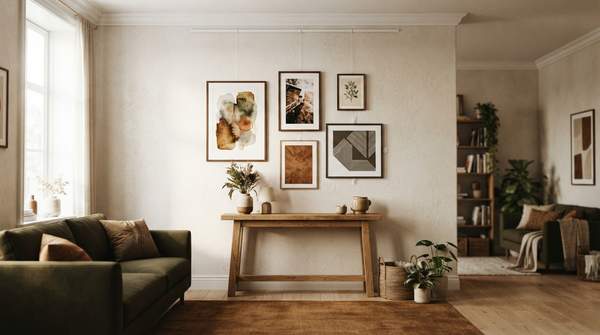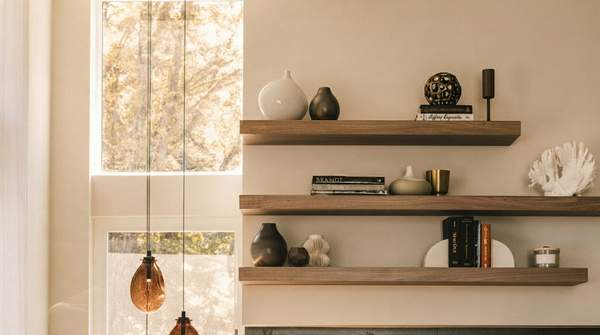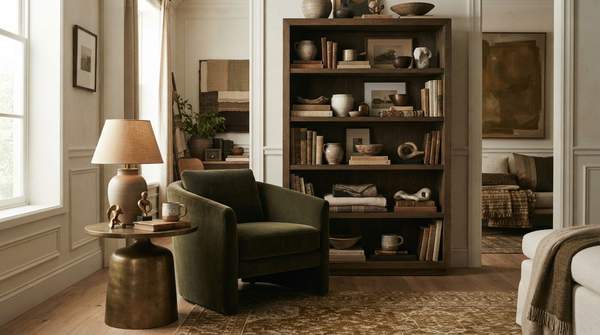
The difference between curated maximalism and clutter is not how much you own—it is whether every object was chosen on purpose. Interior designer Olga Naiman, defining "tidy maximalism" for Livingetc, describes it as layering color, texture, pattern, and personal artifacts "with the discipline of organization and intentionality," a space "brimming with meaningful elements, where every object serves a narrative or functional purpose, arranged with precision to foster harmony and flow." That is the whole game. Below is a repeatable four-part test you can apply to any object, plus the three design principles that keep abundance from tipping into chaos.
The Intentional Heart of Curated Maximalism
Design writers keep converging on the same distinction. Writing for House Digest, Becca Lewis contrasts maximalism with "cluttercore": maximalist layering "requires adherence to a particular style, color scheme, and form," and she cites Robin Baron Design's position that a maximalist design needs structure to convey the right mood, with editing as the way to achieve it. Cluttercore, by contrast, is "all about breaking the rules"—structure gives way to emotion, and it "doesn't stop for clean lines or space."
A useful taxonomy from Dave Spence at Potteries Auctions places intentional clutter—curated maximalism's close cousin—between two extremes. Minimalism focuses on owning as little as possible, with a clean, sparse, neutral aesthetic aimed at simplicity. Hoarding is accumulation without organization, chaotic and overwhelming, driven by emotional attachment without curation. Intentional clutter sits in the middle: "curated abundance," rich and layered but controlled, with the goal of "meaning, beauty, and storytelling."
So the question is never "do I have too much?" It is "does each thing I own earn its place?" Catherine Jordan Design's Cathy Connon, profiling the work of designer Samuel, puts it in narrative terms: maximalism is "about telling the owner's personality and personal history." An object that carries no story, fits no scheme, and plays no compositional role is not maximalism—it is accumulation.
The Curated Maximalism Decision Framework
Here is the practical tool. Take any object in your room and run it through four tests, drawn from the criteria design experts use to define the style: personal significance, aesthetic fit, compositional role, and storytelling. The framework classifies each item as a curated element or potential clutter, giving you a clear keep or re-evaluate decision.
| Test | The question to ask | Passes if… | Result |
|---|---|---|---|
| 1. Personal Story | Does this object reflect my identity, history, or interests? | It carries genuine personal significance or beauty for you, not just habit. | Curated element |
| 2. Design Cohesion | Does it fit my color scheme and style? | Its colors and form echo the palette and style of the room. | Curated element |
| 3. Compositional Role | Does it have a defined place in the arrangement? | It is placed with precision—part of a balanced grouping, not a stray surface deposit. | Curated element |
| 4. Narrative Purpose | Does it contribute to the room's story? | It serves a narrative or functional purpose within the overall design. | Curated element |
| Any test failed | — | — | Re-evaluate: relocate, regroup, or remove |
The reasoning path is straightforward. Naiman's definition supplies the standard: every object should serve "a narrative or functional purpose" and be "arranged with precision." Spence's taxonomy supplies the failure mode: accumulation "without curation." An object that passes all four tests satisfies the expert definition of curated abundance. One that fails any test—no story, no cohesion, no role, no narrative—is behaving like clutter, whatever its individual merits.
Design Principles for Structured Abundance
Once you have decided what stays, three principles give the collection its structure. They are what separate a room that reads as intentional from one that reads as accidental.
A cohesive color palette. Naiman recommends the 60-30-10 rule: roughly 60 percent of the room in a dominant color, 30 percent in a secondary, 10 percent in an accent. And the palette should repeat across surfaces—"if your palette includes deep emerald, warm gold, and rich burgundy, ensure these colors appear in your artwork, textiles, furniture, and accessories." In her words, this "creates visual cohesion even when mixing bold patterns and diverse objects, making the space feel intentional rather than accidental."
Geometric rhythm. Writing on neutral maximalism for The Oblist, the editorial team draws on Bauhaus principles and Scandinavian design philosophy, arguing that geometric patterns "can provide structure within abundance, creating rhythm that guides the eye without overwhelming it." The key, they note, is selecting patterns that feel integral rather than applied—forms that emerge from construction rather than surface decoration.
Strategic negative space. Rachel Silva, writing for ELLE Decor, is emphatic: "Empty space is essential to maintaining balance." Her method is concrete—build smaller, curated groupings rather than covering every inch of a surface, leave gaps between clusters so each grouping has room to breathe, and reserve parts of larger tables and shelves as anchors for a few key pieces. The empty areas let the eye rest and, she writes, give the design "a sense of intentionality and thoughtfulness" while highlighting the objects you have chosen.
Applying the Framework: Editing Your Space
Now put it to work. Pick one surface—a shelf, a mantel, a console—and remove everything. Return items one at a time, running each through the four tests. Keep what passes. Notice how quickly the decisions come: the travel print that echoes your burgundy textiles passes tests two and four; the orphan candle holder that matches nothing and means nothing fails.
Then arrange what remains using the three principles. Cluster the keepers into small groupings with gaps between them, per Silva's guidance. Check that your palette colors recur across the grouping. Look for geometric rhythm in the shapes and patterns you have placed. Step back and ask the simplest diagnostic question the evidence supports: does this read as a room where every object was chosen, or a room where things simply accumulated?
Editing is not a one-time purge. Robin Baron Design's position, as reported by House Digest, is that editing is precisely how maximalist structure is achieved—an ongoing discipline, not a weekend project. Work surface by surface, and let the framework, not guilt or habit, make the calls.
Transforming Your Space: From Clutter to Curated Abundance
Actively apply the four-part decision framework and core design principles to evaluate and arrange belongings, ensuring each item contributes intentionally to a cohesive, personal maximalist space. The measurable indicator of success is a space where every object feels purposeful, contributes to a cohesive aesthetic, and evokes a personal narrative, rather than feeling overwhelming or disorganized. When you can walk through the room and account for why each object is there—its story, its fit, its role, its narrative—you have crossed the line from accumulation to curation.
Sources
- The Key Differences Between Maximalism And Cluttercore - House Digest
- What Is “Intentional Clutter”? The Art of Curated Maximalism - Potteries Auctions — Potteriesauctions
- Maximalism: The Story of You — Catherine Jordan Design
- Okay, 'Tidy Maximalism' Might Perfectly Sum Up My Interior Style — Livingetc
- How to Achieve Neutral Maximalism: Curated Design — The Oblist
- Intentional Clutter Is the New Maximalism — ELLE Decor