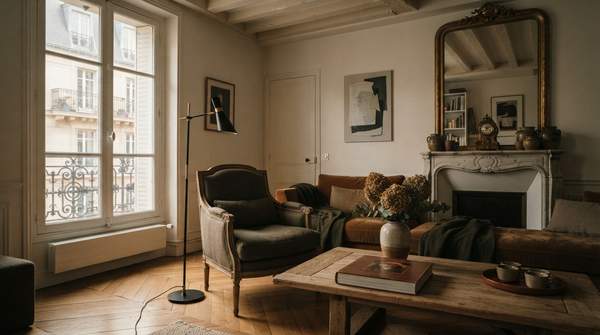
French interior design is not one look but at least two distinct dialects, and choosing between them is the first real decision you will make. The formal Parisian "high-society" aesthetic grows out of Haussmann-era apartment architecture and pairs historical detail with restrained, elegant decoration. French Provincial, by contrast, borrows the graceful lines of royal furnishings but strips away the pretension, favoring comfort and the relaxed feeling of the countryside, as Austin-based interior designer Amity Worrel describes it. Get this distinction right, and every subsequent choice—color, furniture, decor—falls into place.
The Art of Balancing Old and New: Achieving Timelessness
Before you pick a substyle, understand the principle that unites all good French interiors: the deliberate blending of two distant worlds. Writing on French-style interiors, the design team at Hommés Studio describes the signature effect as "an unusual combination of subtle colors and stylized furniture with modern forms." That pairing—antique silhouettes softened by contemporary simplicity—is what keeps a French room from feeling like a museum display or, at the other extreme, like any ordinary modern apartment.
This is the harder discipline than it sounds. The same writers warn that the trend "requires a great sense of arrangement," because combining the historical and the contemporary must be done subtly enough to stay on the right side of good taste. In practice, I think of it as a ratio rather than a rule: one or two genuinely old or old-feeling anchor pieces—a carved commode, an ornate mirror—set against cleaner, quieter modern forms that let those pieces breathe.
The "palace details" the Hommés team highlights offer concrete ways to execute the blend: curtain rods with laces and tassels, generous cushions, large upholstered headboards and quilts. These are textile-driven touches, which means they are accessible. You do not need to renovate architecture to achieve the balance; you need to layer a soft, traditional element onto a modern base, or a sleek modern piece into a traditionally detailed room.
Notice that the principle itself is style-neutral. A Parisian room balances an antique with a minimal modern chair in a neutral palette; a Provincial room balances a distressed farmhouse table with a simple linen slipcover. The mechanics are the same. What changes is the vocabulary of "old" and "new" on each side of the equation—which is exactly what the next two sections establish.