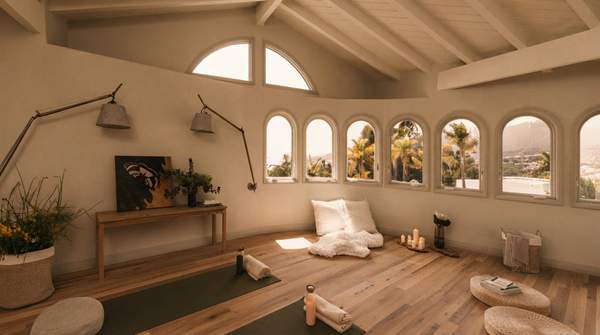
You do not need a greenhouse to make your home feel restorative. The real work of biophilic design happens through light, materials, and layout—and design researchers organize all of it into three categories: Nature in the Space, Natural Analogues, and Nature of the Space. Once you can tell those three apart, every lamp, wood grain table, and reading nook becomes a deliberate psychological tool. Here is how the framework works, what each element actually does to your mind, and how to apply it to your living room and bedroom.
Beyond Plants: Understanding Biophilic Design's Core Categories
Biophilic design is the practice of building our innate pull toward nature into the places we inhabit. The most widely used way of thinking about it comes from the report 14 Patterns of Biophilic Design, which, as summarized by urbanNext, articulates the relationships between nature, human biology, and the built environment. Its central insight is organizational: biophilic strategies fall into three distinct categories that work through different psychological channels.
The first, Nature in the Space, is direct experience—actual light, air, and living things inside your rooms. The second, Natural Analogues, is indirect representation: wood, stone, and patterns that mimic natural forms without being nature itself. The third, Nature of the Space, is spatial—how a room's layout satisfies deep preferences like the ability to survey our surroundings or retreat from them. A research review on biophilic interiors published on PMC frames the payoff across all three: nature connectedness is associated with relaxation, stress relief, lower blood pressure and heart rate, improved cognitive functioning, and increased positive emotions.
Why does this taxonomy matter for a homeowner? Because the three categories fail in different ways. A dim room full of wooden furniture is missing direct light, not texture. A bright, bare room with no protected corner is missing refuge, not sunlight. The framework is diagnostic—it tells you which ingredient is absent.
Nature in the Space: Direct Connections for Mood and Focus
This category covers the genuine sensory presence of nature: daylight, fresh air, and views. Of these, light has the deepest and best-documented psychological reach.
A PMC review of light's effects on circadian rhythms, sleep, and mood reports that light has demonstrated antidepressant effects in age-related depression and can slow progressive cognitive decline in dementia. Light therapy, it notes, is valued in geriatric care for its rhythm-synchronizing properties and its enhancing effects on sleep quality and wakefulness. In other words, light is not décor. It is a regulator of the internal clock that governs both sleep and mood.
How light translates into sharper thinking is less settled. A Frontiers review by Angus Fisk and colleagues notes that while researchers understand the photoreceptors and neural pathways that generate circadian rhythms, "our understanding of the mechanisms by which lighting influences cognitive processes is more equivocal." Light affects alertness directly and may also affect cognition indirectly through disrupted circadian entrainment. For your home, the practical reading is straightforward: getting real daylight into your main rooms supports your sleep-wake cycle and mood, even if the precise cognitive mechanics are still being worked out.
Air and views belong here too. Writing for the University of Central Alabama's art department on biophilic design and health, one observer notes that windows that bring fresh air into a space "enhance everyone's senses," because people are drawn to light, cool or warm breezes that leave "the mind renewed." Openable windows, then, are a psychological device as much as a ventilation one.