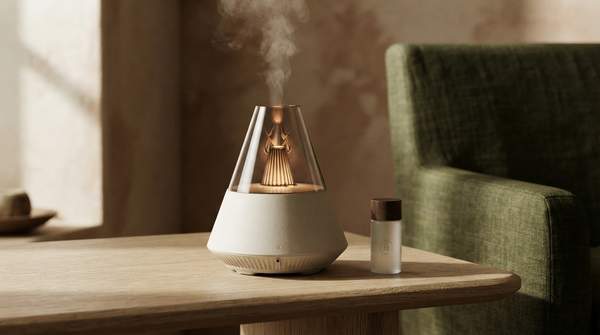
The best compact humidifier for preserving books and wooden furniture is the one that holds your room’s relative humidity steady without dominating the space — and among the models we compared, the Homedics Natura Ultrasonic offers the strongest overall balance of coverage, runtime and design, while smaller desk units trade tank capacity for near-silence and discretion. Dry winter air is the enemy of hygroscopic materials: wood and paper both absorb and release moisture until they reach equilibrium with the surrounding air, as Museums Galleries Scotland explains, and that constant shrinking and swelling is what cracks chair legs and curls book covers.
The good news is that a modest, well-chosen unit can hold a room in the safe zone. This guide walks through why stability matters, what humidity level to target, the trade-offs you’ll face with compact units, and a side-by-side comparison of four evidence-backed models.
Why Stable Humidity is Crucial for Preserving Valuables
Think of a favorite bookshelf not as furniture but as a collection of hygroscopic objects, each quietly negotiating with the air around it. Organic materials — wood, paper, leather, textiles — retain moisture from their plant or animal origins, and they release or absorb it until they match the humidity of the room. Every swing in relative humidity restarts that negotiation, and with it a physical change in dimension.
The stakes are not cosmetic. Preservation literature drawn from decades of museum observation is blunt about the failure modes: humidity should never fall to a level that causes brittle failure of organic artifacts, nor rise high enough for mold to flourish, according to a historical review of museum humidity recommendations hosted by Conservation OnLine. In a domestic setting that means the same two dangers in plainer terms — air dry enough to make paper brittle and wood shrink and split, and air damp enough to invite mold onto a shelf of beloved novels. The goal is not moisture itself but steadiness: a room that avoids both extremes keeps your library and your furniture from performing a slow, daily expansion and contraction.
Optimal Humidity Levels for Preservation
How do you translate museum caution into a number on a home hygrometer? Conservation practice has codified decades of empirical observation of artifacts into recommended “optimum” humidity levels, and the same review of museum guidance identifies the central principle: keep humidity safely above the brittleness threshold and safely below the mold threshold. For home collections of wood and paper, preservation guidance generally centers on a stable range around 40 to 50 percent relative humidity — a middle band that keeps organic materials supple without courting damp.
Two practical points follow. First, the range matters more than any single reading: a room drifting from 30 to 60 percent does more damage than one sitting quietly at 45. Second, a compact humidifier can only raise humidity, not lower it, so in humid seasons the same hygrometer that justified buying one will tell you when to switch it off. Buy a cheap hygrometer before you buy anything else; it is the instrument that turns a decorative appliance into a preservation tool.
Key Trade-offs in Compact Humidifier Selection
Every compact humidifier is a set of compromises, and knowing which ones you’re accepting is half the purchase. The most fundamental is footprint versus capacity. A writer for The Strategist warns that while you might get away with a smaller-capacity model in a compact bedroom used only at night, “the minor difference in footprint size is not typically worth the tradeoff of potentially running out of water in the middle of the night.” Practical desk guidance from Cuttles agrees: a 300 ml tank sounds fine until it’s bone dry by lunch, while tanks in the 1.5 to 2.5 liter range cover most of a workday on a low setting — and if a sink is nearby, a small tank stops being a problem entirely.
The second trade-off is noise, and here technology does the choosing for you. Ultrasonic humidifiers operate in near silence by vibrating a small pool of water until it vaporizes, which is why The Strategist recommends them for most people over evaporative and warm-mist alternatives. Evaporative units push air across a wet wick with a fan — bigger housings, more moving parts, more noise, fine for a whole room but overkill on a desk.
Finally, distrust the decibel figure. Cuttles notes that ratings like 23 dB or 28 dB come straight from manufacturer spec sheets and should be treated as rough comparison guidelines, not gospel; in practice, what bothers owners is rarely the mist itself but quirks like the click of an auto-shutoff or a rattling fan motor.
Comparison of Compact Humidifiers for Preservation
The four models below were chosen to span the design spectrum: a furniture-grade showpiece, two ultrasonic value picks with independent test data, and a pocket-sized desk unit. Where coverage isn’t stated by the manufacturer, the table uses TechGearLab’s measured humidity increase in a test space after 60 minutes — a performance metric rather than a square-footage claim, since real coverage depends heavily on room conditions.
| Model | Type | Coverage | Tank / Runtime | Key Design Feature | Noise Profile |
|---|---|---|---|---|---|
| Homedics Natura Ultrasonic | Ultrasonic, cool and warm mist | 400 sq ft (stated spec) | 60-hour stated runtime | Built-in planter; flat wooden top; described as able to “cameo as a piece of furniture” | Ultrasonic near-silent operation |
| Pure Enrichment MistAire | Ultrasonic cool mist | Small rooms/desk; raised test-space humidity 6.6% in 60 min | Compact tank; frequent refills expected at this size | Low-cost “best value” pick | Quiet; suitable for desk use |
| Levoit Classic 300S | Ultrasonic smart cool mist | Small-to-mid rooms; raised test-space humidity 12.4% in 60 min | Larger tank; refill cadence per usage | Smart features praised for user-friendliness | Quiet ultrasonic operation |
| Homedics desk humidifier | Evaporative wick | Personal desk zone | 8.5 oz; up to 10 hrs plugged in, 3.5 hrs on battery | Sits on a desk “without demanding attention”; runs on USB-C-style battery power | Whisper-quiet per the listing; three spare wicks included |
The pattern across the table is the classic compromise in miniature. The Natura covers 400 square feet and runs for 60 hours between refills, yet it earns its place in a living room rather than hiding behind a sofa: contributor Yelena Moroz Alpert tells Architectural Digest that “the blush hue allows it to cameo as a piece of furniture,” and she rates it 10 out of 10 as a planter, mini side table and night light in one. The Levoit Classic 300S, Good Housekeeping’s best-overall pick for exceptional moisture output and user-friendly features, roughly doubles the MistAire’s measured humidity gain in TechGearLab’s testing. The tiny Homedics desk unit, by contrast, is elegant precisely because it asks for attention nowhere — but 8.5 ounces of water is the price of that discretion.
Making Your Choice: Balancing Preservation and Living Space Harmony
The decision, then, is to choose a compact, design-conscious humidifier that maintains a stable relative humidity between 40 and 50 percent in your living space, prioritizing models that offer adequate tank capacity for your usage, quiet operation and aesthetic integration. Match the machine to the room: for a study or bedroom where the books and furniture actually live, the Homedics Natura’s 400-square-foot coverage and 60-hour runtime make it the strongest single-unit answer, and it looks like something you chose rather than something you tolerated. For a desk-scale target — a single shelf or writing table — the Levoit 300S offers smart controls and stronger measured output, while the MistAire covers the same job at half the price if you need several units around the house, as Good Housekeeping frames its value case.
Whatever you buy, the measure of success is the same: a hygrometer reading indicating stable relative humidity, coupled with quiet operation and infrequent water refills. Set the unit running, check the reading over a few days, and let the number — not the marketing — tell you whether your library is finally at rest.
Sources
- Museums Galleries Scotland
- Development of humidity recommendations in museums and moisture control in buildings — COOL
- 2.1 Temperature, Relative Humidity, Light, and Air Quality: Basic Guidelines for Preservation — Northeast Document Conservation Center
- The 8 Very Best Humidifiers — The Strategist
- Humidifier for Office Desk: 2026 Buying Picks — Cuttles
- The Best Humidifiers — TechGearLab
- The Best Humidifiers Are Helping Us Survive Winter — Architectural Digest
- The Best Humidifiers for Coughs, Allergies, and Dry Skin — Good Housekeeping