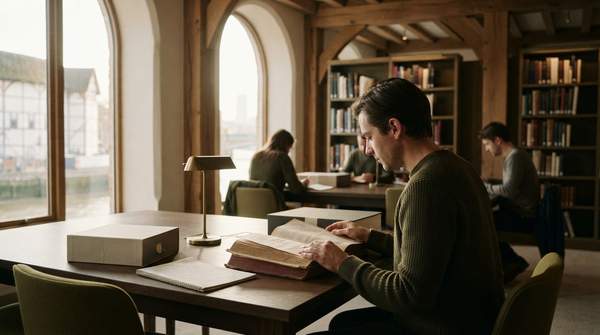
What did readers do before highlighters? They wrote in the margins. Marginalia—everything from scholarly glosses to doodled rabbits playing trumpets—records centuries of people arguing with, decorating, and digesting the texts in front of them. And that record matters more than you might think.
As a Johns Hopkins piece on the archaeology of reading puts it, marginalia "offer the closest insight we're going to get to knowing what somebody thought about a text at the moment he was reading it." That is a rare thing: thought, captured mid-flight.
This article traces that history in the Western tradition, from medieval scriptoria to the age of print, and sorts the markings into the jobs they did. One caution up front: this is not a how-to guide for annotating your own books. It is a look at what the margins of history can teach us about reading itself.
The Enduring Legacy of Marginalia: A Window into Active Reading
Why should scribbles in old books matter to us? Because history is built on reading. The Johns Hopkins essay argues that laws, science, and the story of humanity itself are shaped by what people collectively read—and that understanding how people read at different points in time can help unlock the study of history itself.
Think about that. The contemporary application of U.S. legal statutes can come down to how nine people read the Constitution. Reading is not a neutral act. It never was.
And here is the twist: for most of recorded history, readers were also writers. A widely-cited thousand-year history of marginalia makes the point bluntly. Readers "talked back to texts, questioned them, extended them." The "passive reader," that account argues, is a relatively modern invention—and not a healthy one.
The margins, in other words, are where thinking became visible. The medieval monk writing a gloss was encoding information more deeply than someone who merely read it. The Enlightenment scholar who wrote "Nonsense!" in the margin was forcing himself to articulate his disagreement, which deepened his understanding.
There is a practical side, too. A literature review of marginalia studies notes that libraries, by and large, do not encourage annotators by drawing attention to the manuscript annotations in their collections—Jackson observed that it would seem counterproductive to make a rule and then celebrate the breaking of it. Yet those very annotations are what researchers prize.
Studies of famous readers' marginalia have become a genre of their own. The review cites Jackson's analysis of John Adams's marginalia from 2010, Gribben's 1978 narrative of Samuel Clemens marking Robert Browning's poems, and Ryback's 2008 examination of Adolf Hitler's marginal marks. Even the darkest margins are treated as evidence.
A Journey Through Time: The Evolution of Marginalia
The story of marginalia is a story of shifting purposes. In the medieval scriptorium, margins held formal glosses and whimsical beasts alike. After the printing press, they became more personal and critical. By the nineteenth century, the practice had a name.
The timeline below sequences that evolution, drawing on the British Library's accounts of medieval manuscript art, Oxford's History of the Book project, and the scholarly literature review of marginalia studies. Read it as an arc: communal, decorative, instructional. Then individual, critical, editorial.
| Historical Period | Dominant Forms of Marginalia | Key Examples and Significance |
|---|---|---|
| Medieval period (before printing) | Scholarly glosses, decorative borders, "nota bene" symbols, drolleries—whimsical figures such as animal musicians and fighting snails | Markings served both instructional and decorative purposes, sometimes relating to the text and sometimes purely for humor. Drolleries often depicted "the world turned upside down" themes, reflecting popular medieval ideas. |
| Printing revolution onward | Personal use notes, critical commentary, and editing for publication | Readers began "talking back" to texts, questioning and extending them. Studies document the marginalia of figures such as John Adams, analyzed by Jackson in 2010. |
| 19th century | Extensive, varied annotations by individuals such as Samuel Taylor Coleridge | Coleridge, credited with coining the term "marginalia," marked up multiple copies of the same book in different ways—for personal use, critical commentary, and editing for publication. |
| 20th century to today | Shared social annotation faded, per the marginalia literature review, though similar behaviors are beginning to reappear with e-books | The "passive reader" emerges as a relatively modern phenomenon, often associated with superficial, distracted consumption of digital texts. |
Notice what changed and what did not. The forms shifted with technology and culture. The impulse—to mark, respond, and remember—never disappeared.
The nineteenth century deserves a closer look. Coleridge's practice was layered: he marked one copy for personal use, another for critical commentary, another for editing toward publication. Sometimes a recipient would augment the book with additional comments and return it to the original owner. That shared, social reading, the literature review notes, seems to have faded out in the twentieth century—though similar behaviors are beginning to manifest again with e-books.
The review also records stranger motives. Marginalia has been used for revenge, and as one source quoted in it put it, as "a cheap and convenient form of therapy." The margin was never only a study space.
Beyond the Text: Categorizing the Forms of Marginalia
Not all marginalia is alike. Once you know the categories, you start seeing them everywhere in historical books. Here are the main jobs the margin has done.
Functional and navigational marks
Some marginalia worked for a living. The Oxford History of the Book project describes the "nota bene" abbreviation dotted throughout medieval manuscripts to mark passages requiring careful observation. Drawn in the same ink as the vines curling around the text, these marks served a dual purpose: decorative flourish and instruction—"take note, this is important!"
The symbol was widespread, and literate audiences at the time would certainly have recognized it. Navigation and beauty shared a single stroke of the pen.
Scholarly glosses and commentary
The medieval monk writing a gloss, as the thousand-year history observes, was encoding information more deeply than someone who merely read it. The gloss was a tool of study and transmission—commentary that became part of the next reader's text.
Artistic and humorous drolleries
Then there is the fun. The British Library's catalogue of ludicrous marginal figures includes a fiddle-playing cat, an organist boar, a hurdy-gurdy dog, a psaltery cat, and rabbits drumming and trumpeting. One Book of Hours shows a man fending off a large advancing snail with a club; on the following page, another has cast down his sword and shield and begs for mercy before the ferocious mollusc.
These were not random. The animal musicians likely belong to the popular medieval theme of "the world turned upside down." The idea that animals cannot appreciate music was commonplace in the Middle Ages. A proverb inherited from classical antiquity via Boethius's Consolation of Philosophy called someone who fails to understand something "the ass which cannot hear the lyre." A Middle English poem listing impossibilities includes "whan swyn be conyng in al poyntes of musyke"—when swine are knowledgeable in all points of music, as we might say "when pigs might fly."
The animal musicians might therefore represent the impossible becoming reality. The figures could be narrative scenes, funny creatures, or monsters—sometimes related to the main text, sometimes purely for amusement.
Personal reactions and critical commentary
Later readers left arguments, disagreements, and reflections. The Enlightenment scholar who wrote "Nonsense!" in the margin, as one account puts it, was forcing himself to articulate his disagreement—which deepened his understanding. Coleridge's annotations ranged from personal reflections to critical commentary and editing, sometimes across multiple copies of the same book.
Social annotation
Books circulated. Sometimes a recipient would augment a book with additional comments and then return it to the original owner—a shared, social reading that, per the literature review, seems to have faded in the twentieth century.
And sometimes the margins hid more than they showed. The Oxford project's account of secret messages in manuscript marginalia cautions that not every detail should be read as symbolic, but hidden words prompt us to consider these manuscripts as both works of literature and art—a crossover that directs interpretation and encourages us to think beyond the physical book.
Marginalia as Dialogue: Reading as an Active Process
Here is the deeper lesson. The history of marginalia, as the thousand-year account argues, "demolishes the idea that reading is or should be passive." For most of recorded history, readers were also writers.
What does that look like in practice? Hanover College's history department frames marginalia as part of "active reading"—the kind of reading that forms the core of a liberal arts education. When you read without fully absorbing the content, you waste time you could have spent doing other things. Staying alert means you won't have to read a text a second or third time before you can speak intelligently about it.
Contrast that with now. When we read digital texts, the words scroll by without any landmarks, so we must work harder to grasp the shape of the whole. Hanover's guide, citing the writer Ferris Jabr, reports that people tend to read printed texts with more care than digital ones. Despite our best intentions, we skim digital prose and switch from one site to another—strategies fine for social media posts, less helpful for long-form texts like books or legal documents that call for active reading.
So the "passive reader" is a relatively modern invention. And not, some argue, a healthy one. Research, that account notes, consistently shows that active engagement improves comprehension and retention.
There is even a modern echo of the old practice. High school teachers have experimented with annotation assignments to inspire active reading. Porter-O'Donnell, writing in 2004, described how to train students to mark texts effectively while reading—and reported the students' own reflections on the benefits of the practice.
Reading, the margins tell us, was always a conversation. Somewhere along the way, many of us stopped answering back.
Embracing the Active Reader: A Historical Perspective
Readers should recognize marginalia as a historical testament to active intellectual engagement, fostering a deeper appreciation for the interactive nature of texts throughout history. The medieval gloss, the snail-fighting knight, Coleridge's layered annotations—all are evidence of minds at work, not merely eyes moving over lines.
The measurable indicator is simple: an increased awareness of historical annotations in texts and a critical reflection on one's own reading habits, particularly when engaging with digital content. Next time you open an old book, look at the edges. Someone was thinking there, centuries ago. The question worth carrying forward is whether you are thinking where you read.
Sources
- HUB
- Hidden in Plain Sight: Secret Messages in Manuscript Marginalia – History of the Book — Historyofthebook
- From Manicule to Highlighter: A 1,000-Year History of Marginalia — Glasp
- WKIRI
- Ludicrous figures in the margin — BL
- On Marginalia: Note Taking for College Students : History Department : Hanover College