Art Deco and Bauhaus grew out of the same early twentieth-century moment, but they answer the question "what should a modern room look like?" in opposite ways. Art Deco celebrates modernity through glamour, rich materials, and bold ornament; Bauhaus strips design to its essential purpose, favoring clean geometry, honest industrial materials, and affordability. Once you can read those two visual languages, you can identify either style at a glance—and decide, room by room, which one (or which blend of both) belongs in your home.
Art Deco: Glamour and Geometric Opulence
Art Deco emerged in the 1920s as a celebration of modernity, mechanization, and luxury, representing optimism and technological progress. Its imagery drew on the era's icons—skyscrapers, ocean liners, travel—rendered with bold colors, symmetry, sunbursts, and geometric lines. Everything became stylized, even everyday objects.
The palette is deliberately dramatic. Design educators at the Interior Design Institute describe deep yellows, reds, greens, and blues complemented by black and chrome to enhance a feeling of drama. Gold is frequently used as a statement color rather than an accent, and rich emerald green is a common hue, according to Pam Silvia's design guide for the Appliance Center of Toledo.
Materials carry the mood: lacquered wood, gilded brass, mirrored surfaces, ebony inlay, glass, polished stone, and rich upholstery, alongside natural stones such as jade and obsidian. Velvet and suede dominate the soft furnishings. The forms are bold and graphic—zigzags, chevrons, stepped motifs, and, in the American Machine Age variant, rounded corners and horizontal "speed lines." The overall effect is theatrical, luxurious, and composed for evening light.
Bauhaus: Form Follows Function
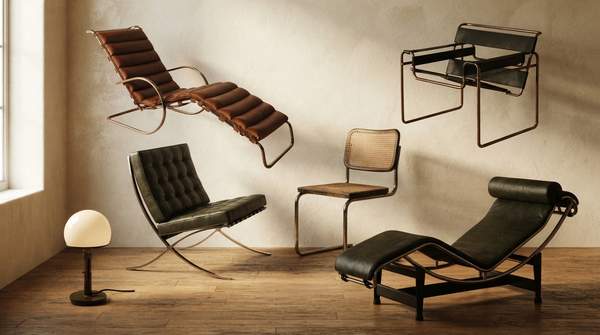
Bauhaus, which flourished from 1919 to 1933, took the opposite path. Its motto, "Art and Technology: A New Unity," aimed to make innovative design accessible to all, as Carina Kümmeke explains in her survey of Bauhaus interiors. Bauhaus creates unity through systems, materials, and construction: the design is simplified so that form, purpose, and production work together.
The visual vocabulary is narrow and disciplined. Red, yellow, and blue; circles, squares, and triangles; intersecting lines. Wood was replaced by metal, inspired by cars and planes. Furniture and interiors focus on usability, often incorporating industrial materials—steel, glass, concrete—chosen for durability and affordability.
Where Art Deco had a broad range of products with no single unified look, Bauhaus is a very specific one, spanning architecture, furniture, posters, textiles, and typography. The mood is clean, abstract, and closely tied to industrial modernity. It is not Mid-Century Modern, though the later movement drew on it; Bauhaus prefers steel and glass where Mid-Century Modern leans toward wood and more organic forms.
Art Deco vs. Bauhaus: A Quick Reference Guide
The clearest way to separate the two styles is to hold them side by side across the dimensions that define them. The table below synthesizes their defining characteristics from multiple design sources; use it as a field guide when you encounter a piece of furniture, a wall art print, or a room scheme and need to name what you are seeing.
| Dimension | Art Deco | Bauhaus |
|---|---|---|
| Core Philosophy | Celebrates modernity, mechanization, and luxury; optimism and technological progress expressed through glamour and non-traditional sophistication | Beauty through reduction, honest materials, and clean geometry; form, purpose, and production unified for usability and accessibility |
| Color Palette | Deep yellows, reds, greens, and blues with black, chrome, gold, and emerald green; gold as a statement color | Primary colors—red, yellow, blue—combined with black, white, and neutral tones |
| Key Materials | Lacquer, chrome, glass, mirrors, gilded brass, ebony inlay, exotic woods, jade and obsidian; velvet and suede upholstery | Industrial materials: steel, glass, concrete; metal replacing wood, chosen for durability and affordability |
| Geometric Forms | Zigzags, chevrons, stepped forms, sunburst motifs, refined symmetry, rounded cabinets and bullnose edges | Simple geometric shapes—circles, squares, triangles—and intersecting lines, stripped of ornament |
| Overall Mood | Dramatic, luxurious, theatrical; rooms composed around evening light and entertaining | Functional, orderly, abstract; rooms organized around systems and use |
The pattern to notice: every dimension inverts. Where Deco adds, Bauhaus subtracts. That opposition is what makes the two styles instantly distinguishable once you know the tell—ornament and luxury on one side, function and reduction on the other.
Integrating Art Deco into Your Modern Home
You do not need a period restoration to borrow Deco's glamour. The Interior Design Institute's practical advice is to balance decorative pieces with the functional layout so the space stays sleek and uncluttered. In American Deco interiors, grand entryways and step-down living rooms created a sense of theater—an effect you can echo with a single confident focal point rather than a full scheme.
For a living room, Art Deco makes a confident focal point above a sofa or sideboard, especially in rooms with dark wood, brass, marble, velvet, or strong color. Sleek coffee and dining tables with brushed brass or gold-plated hardware recall the 1920s, and a sunburst chandelier is a showstopping accessory that instantly signals the era.
Restraint is the modern rule. A matte plaster wall can calm a reflective surface; a simple wool rug can keep a polished table from feeling like a showroom object, as Todd Harmon notes in his history of the style. The question is not whether a piece wears the correct historical costume, but whether it carries the movement's deeper logic: strong form, deliberate surface, and a room composed around light.
Integrating Bauhaus into Your Modern Home
Bauhaus is the easier of the two styles to live with in a contemporary setting, because it integrates most easily with minimalist and modern interiors. It works well with modern furniture, pale walls, and architectural lines—so a room that already leans contemporary needs only a few deliberate additions.
Start with the geometry. A print or object built from primary colors and simple shapes—circles, squares, triangles—announces the style immediately. Pair it with steel, glass, or concrete surfaces and furniture whose form visibly serves its purpose. Keep the palette controlled: primaries against black, white, and neutrals, with no ornament that does not earn its place.
For wall art, Bauhaus usually benefits from simple black, white, or natural-wood frames. The goal is a functional, orderly room where every element has a reason to exist—usability first, decoration only where it clarifies.
Blending Styles: A Harmonious Approach
The two styles can share a room, but they need a referee. Their contrast in mood can add interest rather than chaos if you give the combination a unifying structure. A consistent frame style and a controlled palette can unite pieces from both movements, while the shift in mood—Deco's glamour against Bauhaus's restraint—becomes the room's point of interest rather than a clash.
One reliable strategy is to let one style lead and the other accent: a Bauhaus-ordered room with a single Deco mirrored cabinet, or a Deco-leaning living room grounded by a clean-lined steel-and-glass piece. A curved sofa can soften a hard-edged Deco cabinet, showing how transitional elements earn their place. Black frames are the most versatile choice across both styles, which makes framing an easy place to enforce consistency.
Making Informed Design Choices
Readers should confidently choose between Art Deco's opulent glamour and Bauhaus's minimalist functionality, or thoughtfully combine elements, based on their desired aesthetic and the practical needs of their space. The decision framework is straightforward: ask whether a room should feel theatrical or orderly, luxurious or utilitarian, then select materials, colors, and forms from the matching column of the comparison above.
Success is measurable. The reader successfully identifies and applies specific Art Deco or Bauhaus characteristics in their home design decisions, resulting in a cohesive and intentional interior. A practical test: pick any piece you are considering and name its style and dimension—philosophy, palette, material, form, or mood—before it enters the room. If you can name it, and it serves the room's single governing mood, it belongs.
Sources
- The Interior Design Institute
- Our Guide to Art Deco Interior Design | Appliance Center of Toledo
- The History of Art Deco Interior Design: From 1920s Glamour to Modern Homes — AURA Modern Home
- Bauhaus Style Interiors — Upscale
- Art Deco and Bauhaus – similarities and differences — Sandrajt
- Art Deco vs Art Nouveau vs Bauhaus: Wall Art Guide — GalleryThane