The Renaissance "cabinet of curiosities" was more than a shelf of oddities—it was a deliberate attempt to hold the whole world in a single room. That ambition is exactly what makes the tradition so useful today. By borrowing three of its core principles—building a microcosm, sparking wonder through juxtaposition, and arranging objects by visual resonance rather than strict category—you can transform a scattered personal collection into a display that tells a story instead of merely occupying space.
The World in a Room: Understanding the Cabinet of Curiosities
Beginning in the sixteenth and seventeenth centuries, European collectors—among them members of the rising German merchant class and the Habsburg dynasty—assembled collections of natural specimens, artworks, and artifacts into displays known as Wunderkammern, or rooms of wonder. As Anne Wallentine recounts in Smithsonian Magazine, these were not "simply places of extravagant wealth and strange, weird things," in the words of scholar Matthew Meadow; they also served practical research purposes, fed by expanding travel and trade networks.
The guiding idea was the microcosm: a collection should compress the world into a room. Writing in Architectural Digest, Kristen Bateman quotes curator Elizabeth Semmelhack's colleague Hill describing the logic plainly: "Cabinets of curiosities were meant to be this microcosm of knowledge, so you would collect not just objects from the natural world, but also human-made artifacts." Historical examples ranged from embellished shoes from India to rare jewelry—objects chosen for their beauty and interest rather than their utility.
It is worth noting, as scholars now do, that the ways these cabinets were compiled and displayed are tied to colonialist worldviews; the objects often arrived through the same trade networks that carried their collectors' power. That history does not diminish the display principles themselves, but it is part of the story.
Three Pillars of Wonder: Core Principles of Historical Displays
Three philosophical principles shaped how these collections worked, and each translates directly into modern display thinking.
The microcosm. A cabinet aimed to represent the whole of nature and human making at once—shells beside paintings, fossils beside medals. The point was comprehensiveness of a personal kind: a world rendered legible through objects.
Juxtaposition as an engine of wonder. Placing disparate objects side by side encouraged comparison, the finding of analogies and parallels. According to Horst Bredekamp's analysis, this favored a cultural shift from a static view of the world toward a dynamic one of endlessly transforming natural history. Art historian Barbara Stafford, as cited in an essay on cabinets of curiosity, argues that juxtapositions "served to simulate conversation"—that artifacts "cacophonously 'chatted' among themselves and with the spectator" in what she calls a "system of sideways looks."
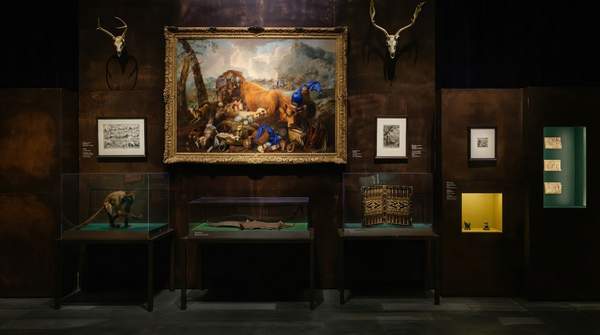
Arrangement by visual resonance, not taxonomy. Historical collectors did not organize like a modern museum. As M.S. Rau's account explains, while some collectors grouped objects by type or in thematic sections to create a narrative, "many collections were organized according to a visual logic, with no strict adherence to categorization or taxonomy." A 2023 exhibition described by Wallentine followed the same spirit: paintings by Rembrandt and Rubens hung beside works by lesser-known figures, arranged by visual riches—water, earth, fire—rather than by artistic hierarchy.
Naturalia and Artificialia: Categories of Curiosity
Historically, displays were often dictated by two primary categories. Naturalia consisted of objects from the natural world: preserved animal and plant specimens, minerals, rocks, shells, and fossils. Artificialia (sometimes called artefacta) designated man-made objects, typically artworks and cultural artifacts such as coins and medals. Many collectors also gathered scientifica—scientific objects and tools.
What gave the cabinet its depth was the interplay between these categories. A carved shell beside a painted one; a natural coral next to a worked gemstone—the boundary between nature and artistry blurred, and that blurring was precisely where wonder lived. The categories are best treated as a lens rather than a rule: a way of noticing which of your objects speak for the natural world and which speak for human making, and then letting them converse.
Reviving the Wunderkammer: Modern Interpretations
The tradition is having a contemporary moment. Bateman reports that the art of collecting is "more popular than ever," with the cabinet of curiosities reappearing in home interiors. The modern revival differs from the original in one crucial respect: where the historical cabinet aspired to encyclopedic knowledge of the world, the contemporary version is personal, reflecting individual taste while retaining the old principles of thematic grouping, juxtaposition, and visual narrative.
Contemporary collectors echo the pattern. Writing for Vault Editions, Kayle Whitham describes artists and creatives whose collections, "much like the Wunderkammern of old," include found objects, an eye-catching flower or leaf, a unique shell—or, in a modern twist, photographs capturing the unusual and memorable sights of everyday life. The scale has shrunk from rooms of large cabinets to a single "curio" cabinet or shelf, but the impulse is the same: objects chosen because each is wonderful in itself and, together, reveal something about their collector's world.
Your Personal Wunderkammer: A Step-by-Step Curation Framework
The framework below translates the historical principles into a repeatable process. Work through the four steps in order; each builds on the last, moving from story to selection to arrangement.
Your Curated Collection: A Decision Framework
| Step | Historical principle | Question to ask | Action |
|---|---|---|---|
| 1. Define your narrative | The microcosm: a collection as a compressed world | What corner of the world does my collection represent? | Name a theme before touching a single object—your microcosm of knowledge, not the whole world. Write one sentence describing what the display is about. |
| 2. Select your objects | Naturalia and artificialia as complementary categories | Which objects speak for nature, and which for human making? | Sort candidates into naturalia (specimens, shells, stones, plants), artificialia (artworks, artifacts, made things), and optionally scientifica (tools, instruments). Keep at least two categories present so they can interact. |
| 3. Arrange for conversation | Juxtaposition simulates conversation between objects | Which pairings invite comparison—analogies, parallels, contrasts? | Place disparate objects side by side deliberately: a natural form next to a made one, a texture against its opposite. Ask what the similarities and differences mean. |
| 4. Find the visual logic | Arrangement by resonance, not strict taxonomy | What hidden connections hold these objects together visually? | Group by visual resonance—color, material, form, or theme—rather than by strict category or type. Let the display follow a narrative path rather than a filing system. |
Two cautions from the historical record will keep the framework honest. First, resist the encyclopedic urge: the historical microcosm was a comprehensive attempt to categorize the world, whereas your display should focus on personal taste and narrative, retaining only the underlying principles. Second, do not treat naturalia and artificialia as rigid boxes—historically the categories blurred, and the blurring was central to the cabinet's appeal. The framework offers conceptual guidance for categorizing your own items, not a fixed taxonomy.
Beyond the Shelf: Cultivating Your Personal Narrative
The decision before you is to transform your personal collection into a meaningful, curated display by consciously applying the historical principles of the cabinet of curiosities: define your microcosm, mix nature and artifice, arrange for conversation, and let visual resonance—not category—govern the final placement. The measurable indicator of success is a display that evokes wonder, tells a personal story, and sparks conversation among viewers, reflecting a thoughtful arrangement rather than mere accumulation. When a guest stops mid-sentence to ask why a shell sits beside a photograph, your wunderkammer is doing exactly what its Renaissance ancestors did: making objects chat.
Sources
- How Cabinets of Curiosities Laid the Foundation for Modern Museums — Smithsonian Magazine
- Is the Cabinet of Curiosities Making a Comeback? — Architectural Digest
- Cabinet of curiosities - Wikipedia — EN
- What is a Cabinet of Curiosities? Wunderkammer, Kunstkammer and Beyond — M.S. Rau
- Cabinets of Curiosity: Our New Image Archive & Exploring the Wunderkammer’s Mythical Objects — Vault Editions LTD