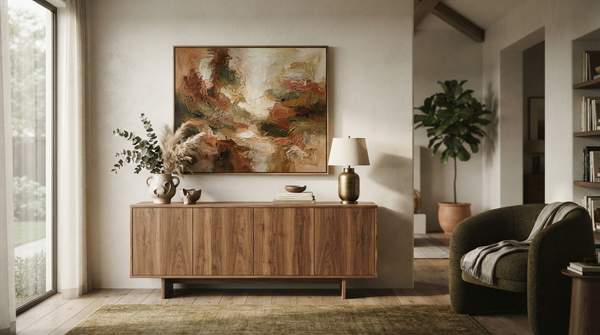
The art you hang on your walls is doing more than filling space. Environmental psychology and the emerging field of neuroaesthetics suggest that the images you live with can support specific psychological states—calm in a bedroom, focus in a study, energy in an entryway. This article offers a decision framework for selecting and placing art based on those principles: connecting a desired mood to concrete choices about an artwork's subject, palette, and form. It draws on general psychological research rather than therapeutic evidence, and its guidance is intended for personal living spaces, not clinical or professional settings. Nor does it point to particular artists or sellers—the point is how to choose, not what to buy.
The Psychology of Your Walls: How Art Shapes Your Home and Mind
A room's visual field is not neutral. A review published through the National Library of Medicine describes growing evidence that viewing art can serve as a pathway to psychological well-being and physical health, and that museum curators routinely design exhibition spaces to elicit awe in visitors. That same logic can travel home: the artworks you pass every morning are small, repeated aesthetic experiences, and each one carries a mood.
Two mechanisms make this work. First, design shapes emotional function at three levels—physical comfort, psychological safety, and emotional fulfillment, as the American Society of Interior Designers outlines in its overview of the neuropsychology of space. Second, the brain's response to art depends on the meaning we bring to it, as the American Psychological Association has reported. In other words, a print of a coastline and a poster of a city skyline are not interchangeable decorations; they are different psychological inputs.
Core Psychological Principles: The 'Why' Behind Art's Influence
Biophilia: bringing nature in. Our brains evolved in natural settings, and design that incorporates natural elements reduces stress and enhances well-being, according to ASID. Nature views have been linked to faster patient recovery and improved student test scores in the research ASID summarizes, and exposure to natural light supports mood and cognitive function. For art curation, this principle points toward landscapes, botanical studies, water imagery, and works echoing organic pattern and order.
Color psychology: setting the tone. Interior color can significantly affect residential satisfaction and psychological functioning beyond its aesthetic value, according to a study of interior color in a university residence hall published through the National Library of Medicine. Writing for Graduate School USA, Rebecca Lockwood frames the practical takeaway: color psychology turns "I like this color" into "This color supports the purpose of the room," letting designers shape mood, comfort, energy, and focus intentionally. An artwork's palette is a concentrated dose of that effect.
Personal meaning: making it yours. Psychologists describe a "knowledge-meaning system" in aesthetic experience—the prior knowledge and personal memories that let someone find significance in a work, as the APA has reported. When a piece moves you, part of the pleasure comes from making sense of it. This is why art chosen purely for trend rarely feels as good as art chosen for resonance.
Your Art Curation Decision Framework
Use this matrix to move from a goal for a specific room to concrete selection criteria. Start with the mood you want in a space, find the matching principle, then apply the artistic characteristics to the works you consider. For example: a bedroom that should feel restful calls for calm; biophilia and a cool, low-saturation palette point you toward a soft-focus landscape or water study, hung where you see it on waking.
| Desired Mood | Space | Artistic Elements to Prioritize | Guiding Principle |
|---|---|---|---|
| Calm | Bedroom, bath, reading nook | Nature subjects (water, forest, sky); cool, muted palettes; gentle complexity rather than visual chaos | Biophilia—nature connection reduces stress (ASID) |
| Focus | Study, desk area, work corner | Ordered, structured compositions; restrained palettes that don't compete for attention; nature imagery tied to cognitive benefits | Color psychology and natural views supporting cognitive function (ASID; Graduate School USA) |
| Energy and creativity | Entryway, studio, living room | Works that evoke awe—vast scenes, dramatic scale, subjects that invite wonder; palettes chosen to energize the room's purpose | Awe induction—linked in research to improved well-being and stress reduction |
| Meaning and attachment | Any space, especially where you linger | Art with personal significance—places lived, memories, cultural connection | Knowledge-meaning system—art's power depends on personal meaning (APA) |
Placement matters as much as selection. A study of residential interiors notes that interior color interacts with the colors of surrounding objects, and the architecture practice Garret Cord Werner makes the same point practically: a room should read as one continuous experience rather than a collection of separate decisions. Hang art where the room's purpose happens—a desk's sightline for focus, above a bed for calm, in the entry view for an energizing first impression.
Beyond Aesthetics: The Lasting Impact of Mindful Art Choices
The research base here is general rather than prescriptive—no study promises that a particular painting will lower your heart rate, and no framework substitutes for professional mental-health care. But the convergence is consistent: nature imagery, considered color, and personally meaningful work are each tied in the psychological literature to dimensions of well-being, and your walls are the most economical place to apply them. Curating with intention turns a decorating decision into a design decision, one you can revisit as your needs change.
Cultivating Well-being Through Art: Your Next Steps
Readers should intentionally select and place art in their homes, guided by this framework and its underlying psychological principles, to actively influence mood and cognitive function. The practical test is a subjective one you can run yourself: choose one room, name the mood you want it to support, apply the matrix above to one new or relocated artwork, and watch for a noticeable shift toward that desired state in the space over the following weeks. If the room doesn't feel different, that's your cue to reassess the palette, the subject, or the placement—each dimension of the framework is independently adjustable, which is exactly what makes art such a flexible tool for well-being.
Sources
- APA
- Viewing art as a pathway to psychological well‐being and physical health - PMC
- Neuropsychology of Space: Designing Environments for Emotional Well-be — ASID
- Interior Color and Psychological Functioning in a University Residence Hall - PMC
- How Psychology Shapes Mood and Space in Interior Design — Graduate School USA
- Color Psychology in Interior Design: How Color Shapes Mood — Garret Cord Werner Architects & Interior Designers