The right indoor water feature comes down to a three-way trade-off: how much space you can spare, how much sound you want, and how permanent you want the installation to be. Tabletop fountains win on flexibility and close-range calm; wall-mounted models claim vertical space as a focal point; freestanding floor units deliver the strongest presence and sound for open rooms. Guides from fountain specialists suggest matching the type to the room first — a home office rarely wants the same fountain as a living room — and then verifying the actual sound before you commit, because a description promising "gentle bubbling" is no guarantee of what you will hear at your desk.
Understanding Indoor Water Feature Types
Indoor water features fall into three practical categories. Tabletop fountains are small, portable units designed to sit on flat surfaces — desks, shelves, side tables, and countertops — and typically range from about 8 to 20 inches. Because they can be lifted and relocated, they suit renters and anyone who rearranges often. Their close proximity means both the visual detail and the sound are experienced at arm's length.
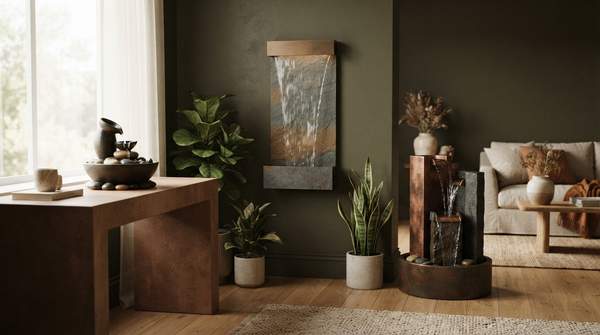
Wall-mounted fountains hang on a vertical surface and typically run from about 12 to 48 inches. They occupy no floor space at all, which makes them attractive where square footage is tight, but they behave more like permanent fixtures: once hung, they are not casually moved, and larger units often require professional installation. Freestanding floor models stand on the ground and carry the largest footprint and water volume of the three. A selection guide from Water Fountain online recommends weighing footprint, the filled load's weight, and circulation clearance around a floor unit before placing it — considerations that simply do not apply to a two-foot desktop piece.
Aesthetic Contribution and Space Considerations
Visually, each type plays a different role. A tabletop fountain integrates into existing décor as an accent you can shift with the seasons; its charm is intimacy. A wall-mounted fountain, by contrast, is often a deliberate artistic element — the thing the eye lands on when entering the room — and lends a more finished, designed feel precisely because it is fixed in place. A floor model anchors a corner or an open stretch of wall and reads as furniture-scale.
Scale matters in both directions. Soothing Company's design guidance warns that a large fountain may overwhelm a small room, while a small fountain may fail to make the desired impact in a large space. That logic points tabletop models toward home offices, bedrooms, reading nooks, and small apartments; wall units toward living rooms, dining rooms, entryways, and larger offices; and floor fountains toward open living areas where their size reads as intentional rather than intrusive. Placement can be creative, too: Soothing Company suggests small fountains can turn a bathroom counter or a shelf near the tub into a spa-like corner.
Acoustic Properties for Relaxation
The sound is, for many buyers, the whole point. TotalPond's guidance on indoor water features describes running water as soothing, with the effect intensifying when the water is physically present in the room, and notes that fountains can serve as natural white noise that promotes restful sleep. That same reasoning makes the sound profile a genuine selection criterion rather than an afterthought.
Yet the range is wide. Sound varies from gentle bubbling to a noticeable trickling — and, in a floor unit with greater water flow, potentially more — so a model that soothes one sleeper may distract another during quiet work. Two cautions follow. First, the same fountain sounds different in different rooms: Water Fountain online's selection guide advises checking "water and pump sound at seating" in a living room and listening "during quiet work" in an office, because room acoustics and distance change everything. Second, product descriptions are not a guarantee of a desired sound level; actual output varies by model. Where sound is the primary goal, seek model-specific sound information or listen before buying.
Maintenance Requirements by Fountain Type
All three types share a pump-and-basin reality: water evaporates, dust settles, and algae will find any warm, sunlit corner. The general rhythm, per Hi-Line Gift's pump-maintenance guide, is a weekly check for floating dust or pet hair, plus a monthly deep clean of the pump to prevent clogs, algae buildup, and poor circulation. Using filtered or distilled water reduces mineral scale, and an algae-preventative treatment helps in warm environments.
Water Fountain online's cleaning guidance adds practical triggers between cleanings: remove leaves and insects when seen, keep the intake clear, maintain the water at the pump's operating level, use partial shade where practical to limit direct sunlight, and empty and clean the fountain when the water turns cloudy, smells unpleasant, or develops a slippery film. What differs by type is burden, not task: a small tabletop unit is quick to carry to a sink, a wall-mounted or floor model makes refilling and cleaning a more deliberate job, and a larger water volume means more to treat and empty. These are general practices — specific requirements vary by model and manufacturer.
Choosing Your Indoor Water Feature: A Decision Framework
The matrix below maps each room to a starting type and the single factor most worth verifying, synthesized from the room-by-room selection guidance above. Read it as a first narrowing, not a final verdict: the priority check is what you confirm before buying.
| Room | Best Fit Type | Top Priority to Verify |
|---|---|---|
| Living room | Floor or tabletop | Water and pump sound at seating distance |
| Home office | Supported tabletop | Splash clearance from papers and electronics; listen during quiet work |
| Bedroom | Tabletop, on a stable surface clear of bedding | Sound/light preference and your refill routine |
| Entryway | Floor or console unit | Clear walking route, solid support, and protected cord routing |
| Bathroom | Only a model approved for the location | Electrical/location rating; ask if unsure |
| Dining room | Corner or wall-adjacent unit | Sound level during conversation |
Notice the pattern in the reasoning: rooms divide by what dominates them. Work rooms are governed by splash and sound discipline, so a compact tabletop unit wins. Social rooms are governed by conversation, so audibility — not volume — is the check. Transition spaces demand clearance and safe power routing, favoring a deliberate floor or console placement. The bathroom row is the one absolute: use only a model rated for that location.
Making Your Choice: A Path to Serenity
Select an indoor water feature type by first considering the room's available space and your primary goal — ambient sound or visual focus — then verifying the actual sound profile before purchase. Skip any comparison of specific products or prices; this framework is deliberately about categories. What you should watch for is concrete: within the first week in place, the chosen fountain should integrate seamlessly into the room's aesthetic and provide the desired acoustic ambiance without disruption — no drowned-out conversation, no splash risk to electronics, no pump whine at your seating distance. If it fails that test, the type was mismatched to the room, and the matrix points you to the next candidate.
Sources
- Indoor Water Fountain Guide: Types, Sound, Size & Where to Place O — Water Fountain online
- Small Indoor Fountains: Enhance Your Space with Tranquility — Soothing Company
- Indoor Water Features: Benefits, Types & Decor Ideas — TotalPond
- How to Clean an Indoor Water Fountain Pump: Simple Steps for Maintenance — Hi-Line Gift Ltd.
- How to Clean a Water Fountain: Algae, Scale & Pump Fixes — Water Fountain online