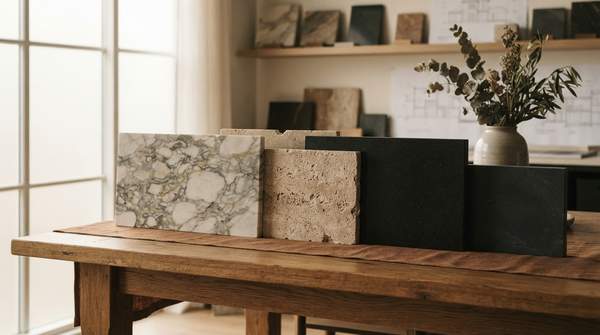
The right natural stone for your project is the one whose durability, maintenance demands, and cost match how you actually live. Granite offers the most resistance to wear and heat; marble brings classic elegance but etches easily; limestone suits low-traffic, rustic settings; and soapstone develops a patina that many homeowners prize. This guide compares all four across the factors that matter most, so you can match the stone to the room rather than the showroom.
Introduction: Choosing Your Natural Stone
Choosing the right natural stone involves weighing durability and aesthetics against maintenance, budget, and sustainability, as stone suppliers like Stone Gallery USA explain in their project guidance. Each stone type offers distinct benefits suited to different applications, and understanding the specific care requirements of each type helps you choose one that fits your lifestyle and ensures long-term beauty and functionality. The practical reality is that no single stone wins every category. A busy family kitchen, a serene bathroom vanity, and a decorative accent wall place very different demands on a surface. The sections that follow break down each stone's character, then assemble them into a side-by-side comparison and an application-by-application guide.
Granite: The Resilient Workhorse
Granite is the most forgiving of the four stones for demanding spaces. A comparison compiled by Erik Finholm of Fin Home Custom Contracting rates granite's heat resistance as high and its scratch resistance as high, with only moderate acid and etch resistance. That combination makes it a natural fit for kitchens, where hot pans and daily food preparation are routine. The trade-off is porosity: granite is a porous stone that requires sealing, and Finholm classifies its overall maintenance level as medium rather than low. Sealing frequency depends on usage and the specific stone type, so a heavily used counter may need attention more often than a decorative installation.
Cost varies widely by grade. Surfaces Galore's 2026 pricing guide places granite between $40 and $175 per square foot installed across budget, mid-range, and premium tiers, while HomeGuide's pricing data lists a typical range of $80 to $150 per square foot installed, or $2,400 to $6,000 for an average-sized kitchen.
Marble: Classic Elegance, Specific Care
Marble is the stone people fall in love with visually and then must learn to live with functionally. Superior Selected Stone's comparison notes that marble is more porous than granite, which offers better resistance to wear and tear. Finholm's breakdown is more pointed: marble's scratch resistance is rated low to moderate, its acid and etch resistance is low because it etches easily, and its maintenance level is high. Acidic spills demand immediate cleanup to prevent permanent etching. Despite that softness, marble remains a genuinely durable material that can last for hundreds of years with proper care, as Superior Selected Stone emphasizes.
On price, Surfaces Galore's tiers run marble from $65 to $250 per square foot installed, with Carrara, the most widely available Italian marble in the United States, sitting at the lower end and premium varieties like Calacatta and Statuario at the top. HomeGuide lists a broader range of $40 to $150 per square foot installed. Finholm characterizes marble's best use case as design-first, low-traffic applications.
Limestone: Earthy Appeal for Low-Traffic Areas
Limestone brings a soft, earthy appeal that suits rustic and Mediterranean-style designs, according to Francini Marble & Granite's guide to natural stone slabs. Its defining limitation is performance under pressure: Francini recommends limestone for low-traffic areas, bathrooms, or outdoor patios, and only with proper sealing. That recommendation is a useful signal for homeowners, because it places limestone outside the running for kitchen counters and heavily used floors. Like the other stones here, limestone is porous and needs sealing to resist staining. HomeGuide prices limestone at $70 to $150 per square foot installed, which puts it in the same band as many granites, so choosing limestone is less about saving money and more about committing to its matte, textured aesthetic and accepting a gentler, lower-traffic placement in the home.
Soapstone: Soft Touch, Enduring Patina
Soapstone occupies a distinctive position among the four. It is soft to the touch, yet Francini includes it alongside quartzite and granite as a best choice for kitchens, precisely because it is heat- and scratch-resistant enough for countertops, backsplashes, and islands. Its signature trait is aesthetic evolution: soapstone develops a natural patina over time, adding to its character rather than degrading it. That aging behavior reframes what maintenance means for this stone. Where marble's etching reads as damage, soapstone's patina reads as depth, and homeowners who choose it tend to embrace the change. HomeGuide prices soapstone at $60 to $130 per square foot installed, or roughly $1,800 to $5,200 for a typical 30-to-40-square-foot installation, making it competitive with mid-range granite and more affordable than premium marble.
Natural Stone Comparison Table
The table below contrasts the four stones across durability, maintenance, typical applications, and installed cost. Cost figures come from HomeGuide's pricing data and Surfaces Galore's 2026 tiered guide, and all ranges vary with slab rarity, color, pattern, and installer.
| Stone | Durability (hardness & scratch resistance) | Maintenance (porosity & sealing) | Typical applications | Installed cost per sq ft |
|---|---|---|---|---|
| Granite | High scratch resistance; high heat resistance | Porous; requires sealing; medium maintenance overall | Kitchens, countertops, backsplashes, islands, high-traffic areas | $40–$175 (Surfaces Galore tiers); $80–$150 (HomeGuide) |
| Marble | Low–moderate scratch resistance; etches easily from acids | Highly porous; requires regular sealing; high maintenance; spills need immediate cleanup | Design-first, low-traffic applications; bathroom vanities | $65–$250 (Surfaces Galore tiers); $40–$150 (HomeGuide) |
| Limestone | Soft; best kept out of heavy use | Porous; needs proper sealing | Low-traffic areas, bathrooms, outdoor patios; rustic and Mediterranean styles | $70–$150 (HomeGuide) |
| Soapstone | Heat- and scratch-resistant enough for kitchen counters | Develops a natural patina over time | Kitchens, countertops, backsplashes, islands | $60–$130 (HomeGuide) |
Read across the rows and the trade-offs emerge directly. Granite pairs the strongest durability ratings with medium maintenance. Marble inverts that bargain: the most storied appearance, the highest upkeep. Limestone and soapstone both reward a considered placement, one by avoiding traffic, the other by welcoming time.
Matching Stone to Project: Application Guide
Francini's application-based guidance turns these properties into concrete recommendations. For kitchens, the best choices are quartzite, granite, and soapstone, because these stones are heat- and scratch-resistant, making them ideal for countertops, backsplashes, and islands. Marble can serve in a kitchen, but its vulnerability to etching means it fits best where design outranks daily durability, as Finholm's design-first, low-traffic characterization suggests. For bathrooms, limestone appears among the recommended stones, provided it is properly sealed, and marble vanities are a natural fit where traffic is lighter than a working kitchen. For flooring, the deciding factor is traffic: limestone suits low-traffic areas, while granite's wear resistance supports busier installations.
Outdoor patios are a listed use for limestone with proper sealing, and soapstone's heat resistance makes it a candidate around hearths and stoves. Each room has different performance needs and visual goals, which is why the same stone can be right in one space and wrong in another.
Making Your Final Decision
Choose the natural stone that best aligns with your project's functional demands, aesthetic goals, maintenance tolerance, and budget. In practice, that means granite for high-traffic, high-heat kitchens; soapstone where a living patina is welcome; marble where elegance justifies vigilant care; and limestone where soft, earthy texture can stay out of heavy use. Two honest caveats apply. First, cost ranges vary by location, slab rarity, and installer, so treat the figures here as orientation rather than quotes. Second, maintenance advice here is general, and specific care instructions should come from your supplier, since sealing frequency and products differ by stone type and usage.
The measurable indicator that your choice was right is simple: the chosen stone maintains its desired appearance and functionality over time with the expected level of care. If a marble counter stays free of etching under your household's habits, or a soapstone surface ages into a patina you enjoy, the decision has done its job.
Sources
- \r\n \n How to Choose the Right Natural Stone for Your Project\n \r\n — Stonegalleryusa
- Is Marble More Expensive Than Granite? 2026 Guide — SurfacesGalore
- Stone Countertops Cost & Comparison [2026 Prices] — HomeGuide
- Marble vs Granite Countertops: Cost & Care Breakdown — Superior Selected Stone
- Kitchen Countertop Cost: Quartz vs Granite vs Marble (2026) — Fin Home Custom Contracting
- Exploring Natural Stone: A Guide to the Different Types and Their Uses — Francini, Inc.