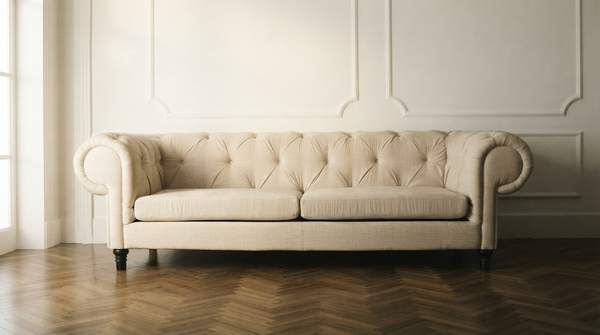
Any upholstered chair or sofa is a structure in disguise. Beneath the fabric sit four layers—frame, support system, padding, and cover—and the durability of the piece lives almost entirely in the three you cannot see. The good news is that each layer leaves observable clues, from the wobble of a leg to the recovery of a pressed cushion. A systematic inspection of these four layers, using the checklist below, lets you judge whether a piece deserves your money, your restoration budget, or a polite pass.
Frame: The Foundation of Durability
Industry writing on upholstery construction is blunt on this point: if the frame is unstable, no amount of fine fabric or cushioning will make the furniture durable. The best frames are made from solid hardwood, often kiln-dried to reduce moisture, prevent splitting, and increase strength; white ash is considered superior, with white and red oak, American elm, hard maple, and birch also common. Softwoods make poor frame material because they lack durability.
Engineered wood complicates the picture. Furniture retailers writing on sofa frames advise avoiding medium-density fiberboard, particle board, and inexpensive standard plywood, while noting that the best engineered hardwood—pressed from at least seven layers of solid wood, sometimes called furniture-grade plywood—can be exceptionally strong. The joinery matters as much as the material. Mortise-and-tenon joints, in which a projecting tongue fits precisely into a matching cavity, remain a standard for quality frame construction, with the tenon typically one-third to one-half the thickness of its parent board.
Corner blocks are the tell you can often actually see. An extra piece of wood placed at an angle and screwed into an inside corner is described by woodworking references as necessary reinforcement, and hybrid construction—traditional joinery supplemented with screws, dowels, or adhesives—adds further strength. Joints fastened only with staples and glue, without blocks or reinforcing, are the weaker configuration to watch for.
Support System: Comfort and Resilience
Two spring systems dominate, and each represents a genuine trade-off. Coil springs create a firm, uniform feel ideal for long-term comfort and are often tied so they stay vertical, distribute weight evenly, and prevent shifting; tied construction allows the springs to move somewhat independently while keeping the seat consistent. A spring-edge design even raises the spring tops above the front rail, forming a flexible floating edge for a softer seat transition. The cost of coils is cost itself, plus the deeper frame space they require.
Sinuous, or "no-sag," springs are S-shaped wires running front to back, clipped to the frame with steel clips and connected by helical springs for stability. They are less expensive and take up less space, which is why they are so common. Their comfort depends on the wire's thickness, resiliency, and the spacing between coils. Whichever system you find, the springs should be securely attached to the frame: loose or shifting springs mean inconsistent support and a seat that will only sag further.