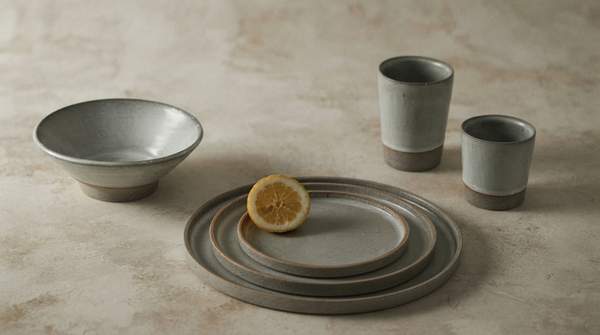
Every plate on your table began as clay and fire, but the temperature of that fire—and what was mixed into the clay—determines whether you own a rustic everyday workhorse or a translucent piece of formal elegance. The four main types of ceramic dinnerware, porcelain, stoneware, earthenware, and bone china, differ in firing temperature, porosity, durability, and character. The short answer: stoneware suits most daily households, porcelain and bone china bring refinement to formal dining, and earthenware rewards those who prize rustic charm over toughness.
Porcelain: The Refined Choice
Porcelain is fired at the highest temperatures of the common dinnerware clays—The Good Trade's editors cite around 2400 degrees Fahrenheit (or 1300+ degrees Celsius)—which yields a dense, vitrified, non-porous body. That density translates directly into performance: porcelain resists water absorption and chipping better than softer ceramics, and its smooth, glossy, typically white surface reads as luxury at the table.
Writing for Michael Aram, Te'a DiNapoli notes that porcelain is "more durable and less porous than traditional ceramic," with better breakage resistance, and that its raw materials—clay, kaolin, feldspar, and quartz sand—may also include glass, granite, or bone ash. This is why porcelain earns its place at formal occasions: it pairs a refined, often luminous appearance with genuine strength. Vancasso's buying guide adds a nuance worth remembering: porcelain is very strong but typically thinner and lighter than stoneware, so it feels delicate in the hand even when it isn't.
Stoneware: The Everyday Workhorse
Stoneware occupies the practical middle ground. Fired at high temperatures—Fluent Trends' guide places the range at roughly 1200°C to 1300°C—it becomes vitrified and non-porous, absorbing little water and shrugging off chips. It is heavier and more substantial in the hand than porcelain, with a rustic, textured, often earthy aesthetic that ranges from casual to refined depending on the glaze.
Earth and Clay, a ceramics seller, frames the choice plainly: pick stoneware "if you want pottery for daily use — especially if you care about durability, ease of cleaning, and long-term performance," calling it the best fit for most households. Vancasso's comparison agrees, slotting stoneware between porcelain and earthenware for "every day + hosting." One practical note from Fluent Trends: stoneware's non-porous body resists stains and moisture, which is part of why it cleans easily and lasts.
Earthenware: Rustic Charm and Practicality
Earthenware is the oldest and softest of the family. Fired at lower temperatures—Fluent Trends cites roughly 1000°C to 1150°C, and HF Coors' Jason Dumont places broader ceramic firing around 1800–2200°F—it remains porous, absorbing water, and is more prone to chipping. In Vancasso's side-by-side, it is the least durable of the three, best reserved for decorative or light use.
Yet its weaknesses are inseparable from its appeal. Earthenware's slightly rustic or matte finish, wide palette of colors, and lighter, traditional character give it a warmth that harder clays can't quite imitate. Earth and Clay recommends it for decorative pieces, sculptural work, or planters, where "the material's character and workability matter more than everyday toughness." It is also usually cheaper, since lower firing temperatures demand less energy. Porosity has a hygiene dimension too: a porous body can absorb moisture, so earthenware asks for more careful care than its vitrified cousins.
Bone China: Lightweight Elegance and Strength
Bone china is porcelain's most storied variation. According to Michael Aram's material guide, bone ash is among the additional materials that can enter the porcelain mixture, and it is this addition that defines the type. The result is a body that is thinner and lighter than standard porcelain while remaining remarkably strong—chip resistance in a wafer-thin rim.
Aesthetically, bone china inherits porcelain's dazzling white, luminous quality—DiNapoli describes Limoges-origin clay, used in fine porcelain, as prized for exactly those hues—and pushes it further toward delicacy. HF Coors' guide positions bone china as the most aesthetically refined option, though also the most costly. For formal dining where a translucent, featherweight plate matters, it is the ceiling of the craft; for a household of daily wear, its price and refinement are better saved for occasions.
Ceramic Dinnerware Comparison: Porcelain, Stoneware, Earthenware, and Bone China
The table below gathers the evidence into one view, so the trade-offs between firing temperature, porosity, durability, appearance, and use case can be read at a glance. Reading down each column shows the pattern the science creates: higher firing means denser, less porous, more durable clay, while lower firing preserves rustic character at the cost of toughness.
| Dinnerware Type | Firing Temperature | Key Properties (Porosity, Durability) | Common Aesthetics | Best For |
|---|---|---|---|---|
| Porcelain | Very high, around 2400°F (1300°C+) | Dense, non-porous, highly durable with strong breakage resistance; thinner and lighter than stoneware | Smooth, glossy, white or luminous; refined and luxurious | Formal occasions and modern tables; everyday use if elegance is a priority |
| Stoneware | High, roughly 1200°C–1300°C | Vitrified and non-porous; highly chip-resistant, sturdy, stain-resistant | Medium to heavy weight; rustic, textured, earthy glazes | Everyday dinnerware and hosting; the versatile middle ground |
| Earthenware | Lower, roughly 1000°C–1150°C | Porous, absorbs water; prone to chipping, least durable of the three | Lighter, traditional, rustic or matte finish in many colors | Decorative pieces and casual or light use |
| Bone china | High, as porcelain, with bone ash in the body | Thin and lightweight yet strong and chip-resistant | Most refined: translucent, dazzling white, delicate appearance | Formal dining where elegance outweighs cost |
One caveat applies across every row: microwave, dishwasher, and oven suitability vary by product and glaze, so always check the manufacturer's guidelines for any specific set before use.
Choosing Your Ideal Dinnerware: A Decision Framework
With the properties mapped, the decision becomes a matter of priorities. Ask yourself three questions, in order of weight:
- How will it be used? Daily meals with family, children, and the dishwasher argue for stoneware's chip resistance and easy cleaning. Formal dinners and holiday tables argue for porcelain or bone china.
- What look do you want? Rustic, earthy, artisanal texture points to stoneware or earthenware; smooth, luminous refinement points to porcelain or bone china.
- What trade-offs will you accept? Earthenware's charm comes with porosity and fragility; bone china's elegance comes with cost; stoneware's practicality comes with weight.
This article compares material types, not brands, and prices vary too widely by maker and retailer to generalize—though Earth and Clay notes that earthenware is usually cheapest because it fires at lower energy, with handmade pieces costing more regardless of type.
Making Your Dinnerware Decision
Choose dinnerware based on a balance of durability, aesthetic preference, and intended use, considering the distinct properties of porcelain, stoneware, earthenware, and bone china. The reader can confidently articulate the differences between ceramic dinnerware types and select a set that meets their specific needs for everyday meals or special occasions. A practical test before you buy: hold a piece, check its weight and finish against the table above, and confirm the manufacturer's care guidelines match how you actually cook and clean.
Sources
- 11 Best Ceramic Plates And Dishes (2026) — The Good Trade
- Ceramic vs Porcelain Dinnerware: What Are The Differences? — Michael Aram
- Stoneware Dinnerware Pros and Cons: Is It Worth It? — Vancasso
- The Difference between Ceramic and Stoneware: The Quick Guide — Fluent Trends
- Earthenware vs Stoneware: 7 Differences You Should Know — Earth and Clay
- Ceramic vs Porcelain Dinnerware: Understanding the Differences — HF Coors