A successful reading nook comes down to four decisions made in order: where it sits, what you sink into, how it is lit, and where the books and clutter live. Design writers converge on this formula—a comfortable seat, suitable lighting, nearby storage, and a location with a sense of separation—and the deciding factor is purpose, not square footage. Even a single square metre can become a place for calm and focus if those four elements are chosen deliberately. What follows is a step-by-step framework, ending in a decision matrix you can apply to your own home.
Understanding the Core Components of Your Reading Retreat
Contemporary design coverage treats the reading nook as a purposeful composition rather than a styled vignette. Home Journal's guide to creating a personal retreat frames the essentials as a clear purpose, comfortable support, and enough separation from distractions, brought together through a seat, lighting, and storage within reach. The modern sensibility shifts away from formality toward something softer and more personal. Mimi Meacham, founder and principal designer at Marian Louise Design, told House Beautiful that "the modern-day reading nook is less about creating a perfectly styled corner and more about carving out a space that feels deeply personal and restorative." Designer Zoe Pinksa of Sidemark Studio, quoted in the same piece, adds that a nook should feel cozy, intentional, and truly usable—function and comfort are not optional extras but the point of the exercise.
Step 1: Selecting the Perfect Location for Your Nook
Start by ruling out the wrong places before ruling in the right ones. Home Journal advises looking for areas off the home's main circulation route and away from sound from the television or dining area; a window spot, a room corner, the end of a hallway, a bedroom alcove, or a recess beside built-in cabinetry can all host an armchair, stool, or platform seat. Scandinavian Designs recommends a quiet area with natural light, such as a sunlit corner in a living room or bedroom or a bay window. Crucially, no dedicated room is required.
House Beautiful notes a nook can be a ledge near a bright bay window, a moody bedroom corner, or "that weird alcove or attic space you've been meaning to make over," and doesn't demand a large footprint. Haven Prints Australia points to attics lit by skylights, and landings or hallways fitted with comfortable seats and decorative screens, as ready-made private reading areas.
Step 2: Choosing Comfortable and Supportive Seating
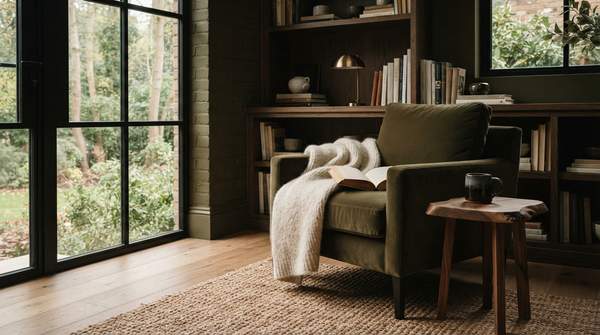
Because a nook exists for long, unhurried sessions, ergonomics matter more than appearance—poor support produces fatigue that no amount of styling can disguise. Haven Prints highlights two seating archetypes: the wingback chair, whose enveloping design offers excellent neck and back support, and the chaise lounge, made for reclining and spreading out with a novel. Layering does the rest. The same guide recommends plush armchairs, daybeds piled with soft blankets, and fabrics that invite touch—velvet, cosy knits, and natural fibres like linen and wool. Nolita Harbour's design essay agrees that natural woods, soft textiles, and matte finishes foster a calming atmosphere, with rugs and cushions adding softness underfoot and at seating level. Materials, it argues, should feel authentic rather than overly polished, since that tactile quality reinforces the space's emotional pull as a sanctuary for relaxation and concentration.
Step 3: Crafting the Ideal Lighting Environment
Lighting is where many nooks quietly fail. The consensus strategy is layering: focused task light from a reading lamp combined with soft ambient light in the surrounding space, as the eye-care writers at iDoctor describe it. Specs matter. Lighting retailer guidance collected by Flyachilles holds that a good reading floor lamp delivers 400–800 lumens of directional task light at shoulder height, controls glare, and allows adjustment—and that when brightness, placement, and color temperature align, "reading becomes effortless instead of fatiguing."
On color, BenQ's technical guidance is specific: warm white or soft white light in the 2700K–3000K range "can help reduce eye strain and improve sleep quality, making them the perfect choice for cozy reading nooks," while cooler 5000K–6500K light suits alert task work. If your corner serves mixed uses, VAXLAMP recommends tunable-white, dimmable lamps that switch from bright and cool to warm and dim. Position matters too: a beam angled behind your shoulder, Flyachilles notes, is one of the small mistakes that compound over time.
Step 4: Integrating Storage and Personal Touches
Storage in a reading nook does two jobs at once: it keeps the current book, reading glasses, and a cup of tea within reach, and it removes the visual distraction that breaks concentration. Pinksa of Sidemark Studio says her team loves incorporating drawers, shelves, or a simple spot for books "so the nook feels both beautiful and thoughtfully functional." Curate rather than accumulate: Home Journal counsels keeping only what is genuinely needed, leaving phones, work documents, and household clutter elsewhere, so even one square metre becomes a quiet place to pause when seating, lighting, modest storage, and a psychological sense of separation all come together. Nolita Harbour frames the payoff in designer terms—through thoughtful furniture selection, layered lighting, and careful spatial integration, these small spaces can feel both sophisticated and deeply personal.
Your Reading Nook Decision Framework
Work through the matrix below for each candidate space in your home. The analytical move is to test your specific space against each component's principle in sequence: first qualify the location, then match seating and lighting to how you actually read, then fit storage to the room the location allows. The output is a personalized plan—one identified choice per row—that you can act on without further research.
| Component | Key Consideration | Design Principle to Apply | Your Decision |
|---|---|---|---|
| Location | Selection criteria | Off the main circulation route, away from TV or dining noise, with natural light if possible; purpose and separation matter more than square footage—consider corners, bay windows, hallways, landings, alcoves, or attic spaces. | Name your chosen spot and its quiet-hour conditions |
| Seating | Comfort and support | Prioritize back and neck support for long sessions (a wingback chair supports both; a chaise invites reclining); layer cushions, throws, and tactile fabrics such as linen, wool, velvet, or knits. | Choose a seating type and textile layers |
| Lighting | Function and eye comfort | Layer 400–800 lumens of adjustable task light at shoulder height with soft ambient light; use warm white 2700K–3000K bulbs to reduce eye strain, or a tunable, dimmable lamp if the space is used for more than reading. | Specify your lamp, its placement, brightness, and color temperature |
| Storage | Organization and personalization | Keep books and essentials within arm's reach using drawers, shelves, or a simple book spot; exclude phones, work items, and clutter so the space reads as a retreat, not a landing zone. | Choose your storage type and your "no clutter" rule |
The framework's qualification logic prevents common missteps: a beautiful but high-traffic location fails at row one regardless of what follows, and seating chosen for looks alone will undermine long sessions even in a perfect corner. If a row cannot be satisfied—a hallway with no outlet for a lamp, an alcove too narrow for supportive seating—treat that as a signal to test a different candidate space rather than to compromise within a flawed one.
Creating Your Personal Sanctuary
Homeowners can successfully create a functional and deeply personal reading nook by following a structured decision process for location, seating, lighting, and storage. The design writers agree that the transformation comes from integration—each choice reinforcing the others until a corner becomes a retreat rather than a collection of furniture. The measure of success is a designated, comfortable space in the home that consistently invites and facilitates focused reading and relaxation. If your chosen spot draws you back evening after evening, book in hand and undistracted, the framework has done its work; if it doesn't, revisit the row where the choice was weakest.
Sources
- Reading Nooks Are Back—and They’re Nothing Like You Remember — House Beautiful
- How to Create a Personal Retreat at Home: 5 Reading Nook Ideas - Home Journal
- How to Create a Reading Nook in Your Home — Scandinavian Designs
- 5 Cozy Reading Nook Design Tips — Haven Prints
- The Return of the Reading Nook: Creating Intimate Spaces in Luxury Homes - Nolita Harbour
- The Best Lighting for Reading to Protect Your Eyes — iDoctor
- Reading Nook Floor Lamps: 5 Pro Tips to Find Your Perfect Reading Ligh — Flyachilles
- What are the Best LED Colors for Reading and Studying? Unlock the… — BenQ
- Warm vs Cool Light for Reading — VAXLAMP