The right compact desk is less about finding the smallest one and more about matching the desk's shape to your room's specific weakness—whether that's scarce floor space, a dead corner, or a living room that must not look like an office. Five desk archetypes dominate the small-space conversation: wall-mounted, corner, fold-down, standing, and console or writing desks. Each trades something away. Here is how they compare, and how to choose.
Choosing the Right Compact Desk for Your Small Space
A desk earns its footprint. In a small home office, every inch the desk occupies is an inch unavailable for living, and furniture guides consistently frame the purchase as a balancing act among surface size, storage needs, and layout constraints. Some desks buy back floor space by climbing the wall; others reclaim corners nobody uses. A few, like fold-down designs, shrink to almost nothing when the workday ends, which suits rooms that change jobs between morning and evening.
The catch is that space efficiency and robustness often pull in opposite directions. Groen's Fine Furniture's 2026 buyer guide captures the tension neatly: a wall-mounted desk "saves floor space, but limits load and flexibility," while a fold-down model "disappears easily, but feels lighter duty." Knowing which compromise you can live with is the whole decision.
Compact Desk Comparison Matrix
The matrix below evaluates all five archetypes against the same four criteria: footprint, storage, best use case, and trade-off. Storage and use-case entries appear only where the evidence supports them—corner desks, for instance, are strong on space but not consistently documented for integrated storage.
| Desk Type | Typical Footprint | Storage Options | Best For | Key Trade-off |
|---|---|---|---|---|
| Wall-mounted | Compact, wall-based; relies on wall support to reduce floor usage and use vertical space | Shelving in some designs; storage layout varies by model | Narrow rooms or limited square footage where an open feel matters | Limits load and flexibility; sturdiness can be a concern for prolonged use |
| Corner | Corner-oriented footprint | Not consistently documented for this type | Dead-space corners that would otherwise go unused | Needs a true corner; the keyboard side can feel tight |
| Fold-down / drop-leaf | Very small when closed | Not consistently documented for this type | Multi-use rooms where the workspace must disappear | Feels lighter duty than fixed desks |
| Standing | Small to medium footprint | Not consistently documented for this type | Tight rooms that need flexibility | Adjustable comfort, but stability depends on frame |
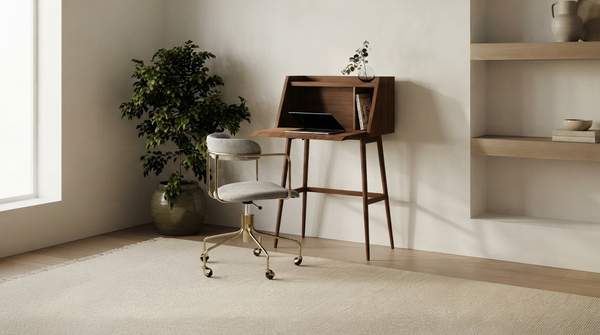
| Console / writing | Slim, console-proportioned (one documented example measures about 47 inches wide) | May include discreet drawers (documented example) | Blending into living spaces as decorative furniture | Design-forward rather than storage-focused; not built for multi-screen spreadsheets or heavy filing |
Read the table as an elimination tool as much as a shopping aid. No corner available? Cross off the corner desk. Setting up permanent daily work with heavy equipment? The fold-down and wall-mounted columns drop away. Once two candidates survive, the room-challenge guide below breaks the tie.
Matching Your Desk to Your Room's Unique Challenges
Narrow rooms and scarce floor space. Wall-mounted desks are the natural fit. Because they lean on the wall for support, they reduce floor usage and exploit vertical space instead, keeping the room visually open. Architectural Digest's small-desks guide recommends exactly this approach: choose a wall-mounted desk with shelving to make use of your home's vertical space. The qualification matters, though—these desks limit load, so they suit lighter setups.
Dead corners. A corner desk fills square footage nobody else wants. Groen's guide calls it an efficient use of space, but flags the same trade-off twice over: it requires a room with a true corner, and the keyboard side can feel tight. If your corner exists but is shallow, measure before committing.
Multi-use rooms. Rooms that moonlight as dining areas, guest spaces, or walkways need furniture that can vanish. A fold-down or drop-leaf desk is very small when closed and disappears easily, preserving the room's flexibility. Lenovo's small-space buying guide reinforces the principle: foldable frames suit spaces where furniture arrangement changes frequently, and flexibility depends on how often the desk needs to be relocated or stored.
Rooms that need to adapt hour by hour. Standing desks occupy a small to medium footprint and suit tight rooms that need flexibility, with adjustable comfort as their headline benefit. Stability, however, depends on the frame—a reminder that the base quality matters more than the lift mechanism.
Integrating Your Desk Seamlessly into Home Decor
Not every small desk needs to announce itself as office equipment. Freed from accommodating multi-monitor spreadsheets and filing cabinets, as Wirecutter's desk reviewer Joshua Lyon puts it, "a desk can be design-forward and enhance your existing decor." His testing philosophy is explicit about why: he knows "how important aesthetics are to keeping work from overpowering your personal space."
The console or writing desk is the archetype that takes this furthest. Architectural Digest highlights a Castlery desk whose fluted panels and discreet storage drawers make it polished enough for non-office settings—it can double as a vanity or a living room sideboard. That dual role is the strongest argument for the category: in a studio or shared living space, the desk simply becomes another handsome piece of furniture when the laptop closes.
Materials and finishes carry the illusion. The documented examples span solid oak, oak veneer, MDF, plywood, and engineered wood, with finishes including oak, smoked oak, and black. Wirecutter's long-term testing also adds a practical note: one desk's surface showed fingerprints that wiped away easily but needed frequent cleaning, and a lighter finish's maintenance depends heavily on the user's habits—a real consideration if your desk lives in a living room rather than a dedicated office.
Your Ideal Compact Workspace Decision
Choose a compact desk type that aligns with your room's spatial constraints, storage requirements, and desired aesthetic integration, prioritizing either floor space, corner utilization, flexibility, or seamless decor blending. The sequence is simple: first identify your room's defining constraint (no floor to spare, an unused corner, a room that must transform, or decor that must survive); then consult the matrix and keep only the types whose trade-off you can genuinely accept.
For most small-space dwellers this narrows the field to one or two candidates: wall-mounted or fold-down when floor space is the scarcest resource, corner desks when geometry offers a freebie, standing desks when flexibility ranks first, and console desks when the workspace must belong to the home rather than the job. You have made the right choice when you have identified desk types that fit your specific needs and can confidently proceed to explore models within those categories—measuring your wall, corner, or clearance first, so the archetype you pick actually fits the room you have.
Sources
- Best Desk for Small Office: The 2026 Buyer's Guide — Groen's Fine Furniture - Dyer, Crown Point Furniture Store
- These Small Desks Make a Big Impact — Architectural Digest
- How to Choose the Best Computer Desk for Small Spaces in 2026 — Lenovo
- Our Favorite Writing Desks (That Don’t Look Like Office Furniture) — Wirecutter: Reviews for the Real World