Minimalist interior design is not about living with as little as possible. It is a repeatable decision process: reduce a room to its essential elements — functional furniture, a tight neutral palette, and open negative space — and then choose fewer, better pieces that have room to breathe. Design writer Dim Kuzmenko captures the common misconception well: a well-executed minimalist interior feels warm and considered, not sparse. The discipline lies in the editing. This article gives you a five-principle framework — function, editing, palette, quality, and negative space — and shows how to apply it to your furniture, color, and decor.
The Five Principles of Intentional Minimalist Design
Behind every clean minimalist room are a few repeatable rules, according to Maverick Frame Studio's design guide: get them right and the style holds together; ignore them and a space slides into either clutter or sterility. The five principles work together as a filter for every object you own or consider buying.
- Function first. Every item must serve a purpose; if it is purely decorative, it has to earn its keep.
- Edit relentlessly. Declutter to the essentials, then remove a little more.
- Limit the palette. Stick to two or three neutral tones across the whole space.
- Choose quality over quantity. A few well-made pieces beat a room full of filler.
- Let negative space work. Empty walls and clear floors are intentional, not unfinished.
These principles echo what Architectural Digest's writer Katherine McLaughlin describes as the style's ultimate test: a minimalist room may look "really well edited or really well curated," and you might even think something is missing — "but really, it has everything that someone needs for that environment," in the words of designer Clarke, whom McLaughlin quotes. Minimalism is about being purposeful, not about asking how little you can live with.
Your Minimalist Design Decision Framework
Use the matrix below whenever you evaluate an existing item or contemplate a new purchase. Run each object through the five principles in order; the first principle that fails tells you what to do. This is the structured process that turns abstract minimalism into consistent, repeatable choices.
| Principle | Question to ask | If the answer is yes | If the answer is no |
|---|---|---|---|
| Function First | Does this item serve a clear purpose in this room? | Keep it and move to the next test | Remove it, or relocate it to a room where it has a job |
| Edit Relentlessly | Is this item part of the true essentials, or could the room function without it? | Keep it | Remove it — declutter to the essentials, then remove a little more |
| Limit the Palette | Does this item sit within your two or three neutral tones? | Keep it | Remove or replace it; off-palette items break cohesion |
| Quality Over Quantity | Is this piece well-made enough to be one of the few you keep? | Keep it as a featured piece | Replace it with one better piece rather than several fillers |
| Let Negative Space Work | Does keeping this item preserve open space around it? | Keep it, with breathing room | Remove it — crowding defeats the calm the style depends on |
The framework works in both directions. When decluttering, an item must pass all five tests to stay. When shopping, a candidate that fails any single test should not enter the house. That asymmetry — strict on the way in, strict on the way through — is what keeps a minimalist space from drifting back toward clutter.
Function First: Designing for Purpose
Functionality is the foundation of the style. StyleNations' design guide defines minimalism as rooted in "less is more," where spaces are stripped to their fundamental elements with an emphasis on clean lines, uncluttered surfaces, and a focus on functionality. In practice, that means every furniture choice starts with a question of use, not appearance: where will you sit, store, eat, or read?
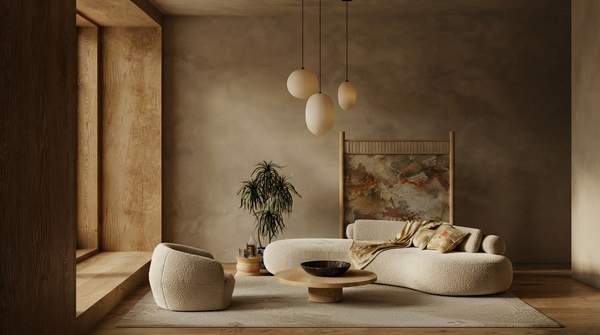
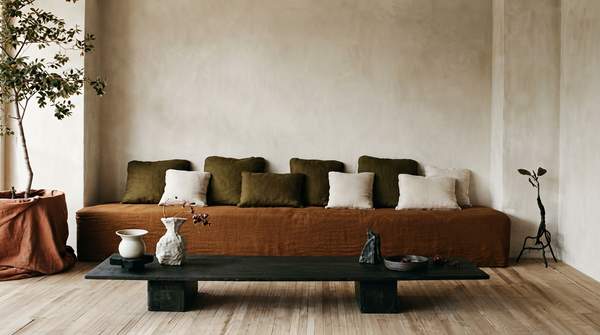
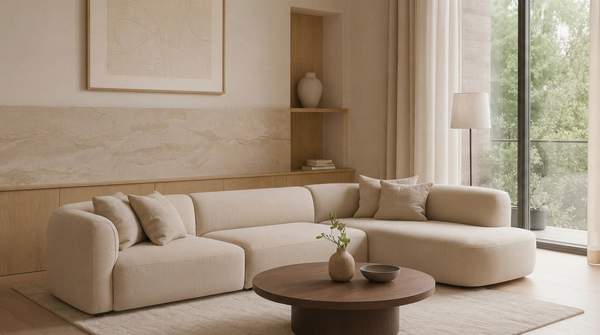
Applied to a living room, Maverick Frame Studio recommends anchoring the room with one low-profile sofa and a single coffee table — then stopping. The restraint is the point. A low-profile sofa keeps sightlines open and reinforces the sense of space, while the single coffee table forces every other surface to justify itself. If an existing piece serves no clear purpose, the framework's first test has already answered whether it belongs.
Function also extends to the architecture you already have. Castlery's design guide advises celebrating existing features — exposed beams, concrete walls, large windows, or vaulted ceilings — rather than covering them up, letting them become prominent focal points. Working with what a room already does well is often more effective than adding new elements to it.
Mastering the Minimalist Palette and Materials
Color is where cohesion is won or lost. The framework's palette principle calls for two or three neutral tones held consistent across the whole space. Castlery notes that the style often employs monochromatic color schemes, with other colors used sparingly as accents. A tight palette creates the calm, serene atmosphere the style is known for and lets the few objects you keep stand out.
Materials and quality are inseparable from this principle. Maverick Frame Studio emphasizes selecting fewer, higher-quality pieces — meticulously crafted for comfort and practicality — over a room full of filler. When your palette is neutral, texture and craftsmanship carry the visual interest: the weave of a fabric, the edge of a table, the finish of a floor. That is why the quality test sits inside the framework rather than beside it. A cheap piece in a neutral tone still reads as filler; a well-made one reads as intentional.
Clean lines reinforce the palette's effect. Castlery points to the sleek edges of a modern sofa or the simple silhouette of a minimalist pendant light as contributors to an uncluttered, sophisticated look. Straight, unadorned lines in furniture and decor keep the eye moving smoothly rather than snagging on ornament.
Strategic Decluttering and Decor with the 3-5-7 Rule
Editing is the engine of the whole process, and it has a natural endpoint: a room that contains everything needed for that environment and little else. Architectural Digest's sources describe the result as exuding peace, tranquility, and calm — a space where "your eye has somewhere to really rest," as Clarke puts it. Declutter to the essentials, then remove a little more; the second pass is usually where serenity appears.
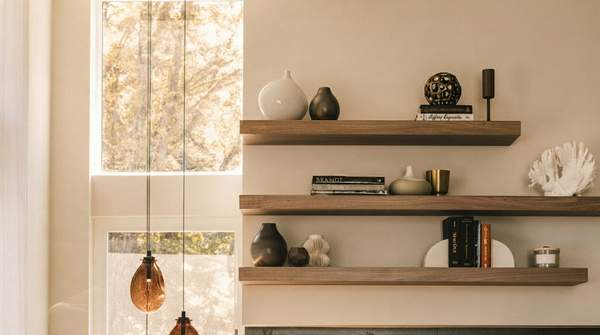
Once you have edited, the few decorative objects you keep still need arranging. This is where the 3-5-7 rule comes in. Maverick Frame Studio explains it as a decorating guideline: objects look more balanced when grouped in odd numbers — threes, fives, or sevens — rather than even sets. In minimalist interiors it is used sparingly: a small, odd-numbered grouping on an otherwise empty surface creates a focal point without reintroducing clutter. The rule is presented as a common technique for intentional placement rather than a formal standard with a documented origin, but its logic is straightforward — an odd grouping feels composed rather than symmetrical, which suits a style built on curation.
Pair the rule with the negative-space principle. One grouping of three objects on a clear surface works; three groupings of seven do not. If a surface already holds a focal grouping, leave the next surface empty.
Transforming Your Home with Minimalist Principles
Apply the five-principle framework to systematically declutter and make intentional design choices for a serene and functional living space. The payoff, as Maverick Frame Studio frames it, is a space that feels warm and considered rather than sparse — the difference between a room that is merely empty and one that is perfectly equipped for how you actually live.
Work room by room, since the principles stay constant while their application shifts with each room's function. Run every existing item through the decision matrix, hold new purchases to the same five tests, and let empty walls and clear floors do their quiet work. The measure of success is concrete: a noticeable reduction in visual clutter and an increased sense of calm and purpose in your home's environment. When a visitor's eye can rest anywhere in the room and find only what belongs there, the framework has done its job.
Sources
- Minimalist Interior Design: Principles & Characteristics — MAVERICK FRAME STUDIO
- Minimalist Interior Design: Everything You Need to Know About This Intentional and Pared-Down Style — Architectural Digest
- Minimalist Interior Design Defined And How To Make It Work - StyleNations
- Expert’s Guide to Minimalist Interior Design — Castlery