Production designers working on historical dramas do not aim for perfect replication of the past. Their goal, as Berlin-based production designer Reinhild Blaschke describes it, is design so convincing that viewers "forget they're actually watching a movie and start believing they're living in that period instead." That means deep research, deliberate compromise, and a constant negotiation between what history documents, what the story needs, and what the camera will find beautiful.
Introduction: Crafting Believable Worlds
The set of a period drama is not a museum exhibit. It is an argument about how a world should feel. Blaschke, who has designed period films including the Klondike Western "Gold," shot on location in Canada in 2012, and the late-GDR coming-of-age story "What Might Have Been" from 2018, describes period work as "a constant exploration process" rather than a checklist of correct objects. Her most satisfying moment, she says, is standing on a lit set with the cast in place and feeling that she has "actually traveled in time."
That feeling, not factual completeness, is the real deliverable. A theatre essay on historical accuracy from HIDden Theatre makes the same point from the audience's side: if the goal is 100% authenticity, that hurdle "is automatically going to limit your audience to an extremely small number of people." Believability, not accuracy, is the working standard.
The Research Imperative: Diving Deep into History
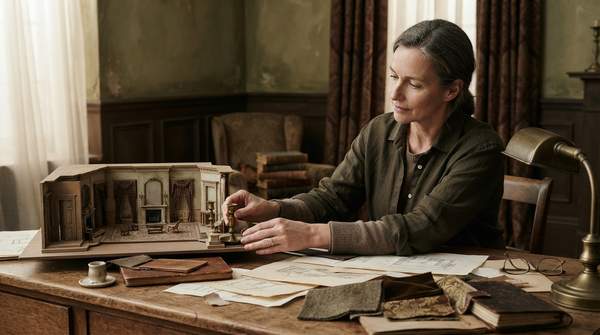
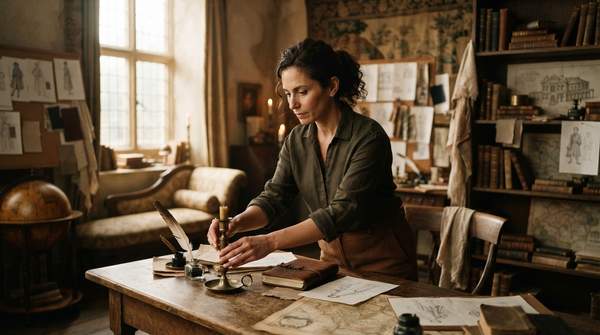
Blaschke's research method is strikingly analog. "In feature films I try to use the internet as last resort, as it is the easiest approach," she says — a notable stance from someone who has been online since 1992. The easy path, in her view, produces shallow results. She goes "very deep into all details," because only when the details are right can the design become believable.
Crucially, the research is not gathered for its own sake. She integrates everything into "very detailed concepts and mood-boards," documents shared beyond the art department with camera and costume so that every team works from the same visual logic. The research exists to inform creative decisions, not to copy historical records. She acknowledges the cost: this approach "can often be seen to be time consuming or costly," but argues it gives the work "a depth and authenticity that will resonate with the audience and show integrity."
The Designer's Dilemma: Accuracy vs. Storytelling
Here is the tension at the heart of the craft. The historical record is incomplete in a fundamental way. As the HIDden Theatre essay observes, "knowing the facts doesn't mean we know the thoughts or feelings behind them." Drama must fill that hole — ascribing motivations and inner lives that go beyond documented fact. This is unavoidable, and it "may open the door to charges of 'inaccuracy,' but it would in most cases be equally hard to make a watertight case for an 'accurate' version."
Designers respond to this gap with intentional license. Blaschke describes one approach in which she might "bring in elements from the 20th century, without anybody noticing it right away, but to give the design a certain special touch." The anachronism is not an error; it is a deliberate aesthetic instrument, invisible to the audience but felt by it. She treats strict-fidelity and interpretive approaches as equal thrills and refuses to prefer one over the other.
A Framework for Creative Compromise
What holds these choices together is an iterative discipline. Blaschke's process requires zooming in on tiny details and then zooming out to check the whole, preventing fixation on isolated facts at the expense of the film's coherence. The matrix below organizes the competing goals and constraints that shape what finally appears on screen.
The Production Designer's Decision Matrix
Use this matrix to analyze any period film's design: identify which goal or constraint dominates a given choice, and the deviation or fidelity becomes legible as a decision rather than a mistake.
| Aspect of design | Goal or constraint | What it means | Qualification |
|---|---|---|---|
| Design philosophy | Balancing act | Continuous negotiation between historical accuracy, narrative requirements and aesthetic vision | Requires zooming in on details, then out again, to avoid getting lost in minutiae |
| Audience expectation | Believability, not replication | Design aims to make viewers feel they are living in the period, not watching a movie | 100% authenticity would limit the audience to an extremely small number of people |
| Artistic license | Narrative vs. history | Elements outside strict period accuracy may be introduced for a "special touch" | A deliberate choice, meant to be felt rather than noticed |
| The historical hole | Incomplete record | Facts document events, not thoughts or feelings; drama must fill the gap | An "accurate" version is rarely more watertight than an interpretation |
| Research method | Depth over convenience | Internet as last resort; deep detail work consolidated into concepts and mood-boards | Time-consuming and costly, but shared across camera and costume departments |
Read across the rows, the matrix shows why a historically "wrong" set can still be the right design: each row represents a legitimate pressure, and the designer's job is to weigh them against one another rather than obey any single one.
Evaluating Historical Dramas: Beyond Simple Accuracy
When watching a historical drama, evaluate the set design not solely on strict historical accuracy, but on how effectively it creates a believable world that supports the narrative and aesthetic vision. The evidence here points to a clear shift in how to watch: Blaschke's anachronisms are designed to pass unnoticed while shaping mood, and the historical record itself cannot supply the inner lives drama requires. The measurable indicator is the coherence and immersive quality of the film's world, and how specific design choices contribute to character and story development. A set that achieves time-travel believability has done its work — even when, somewhere in the frame, the twentieth century is quietly hiding in plain sight.
Sources
- How do you conduct historical research? — Production Designers Collective
- Pondering Historical Accuracy — HIDden Theatre